
Hourly Rate to Salary Calculator Australia
Convert your pay between hourly, weekly, fortnightly, monthly and yearly, both ways.
Your annual salary
that is $0 an hour, at 38 hours a week
Your pay, every cycle
| Period | Gross |
|---|
After-tax figures assume an Australian resident for 2026-27 with no HECS. For super, HECS and residency options, see the take-home pay calculator.
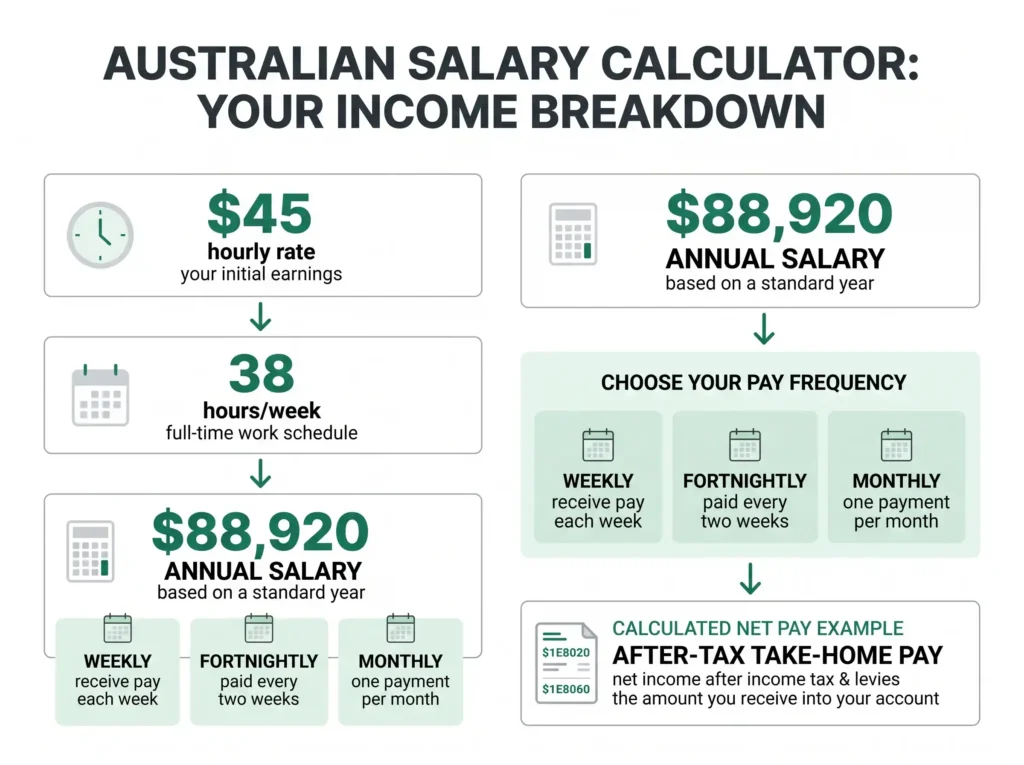
This hourly rate to salary calculator turns your pay into every figure you might need: an annual salary from an hourly rate, an hourly rate from a salary, and the weekly, fortnightly and monthly amounts in between. Enter a number in any box and the rest update at once. It uses standard Australian working hours and, if you switch on the after-tax view, ATO rates for the 2026-27 financial year. It was reviewed by James Wilson, CPA and registered Tax Agent.
How do I convert my hourly rate to a salary in Australia?
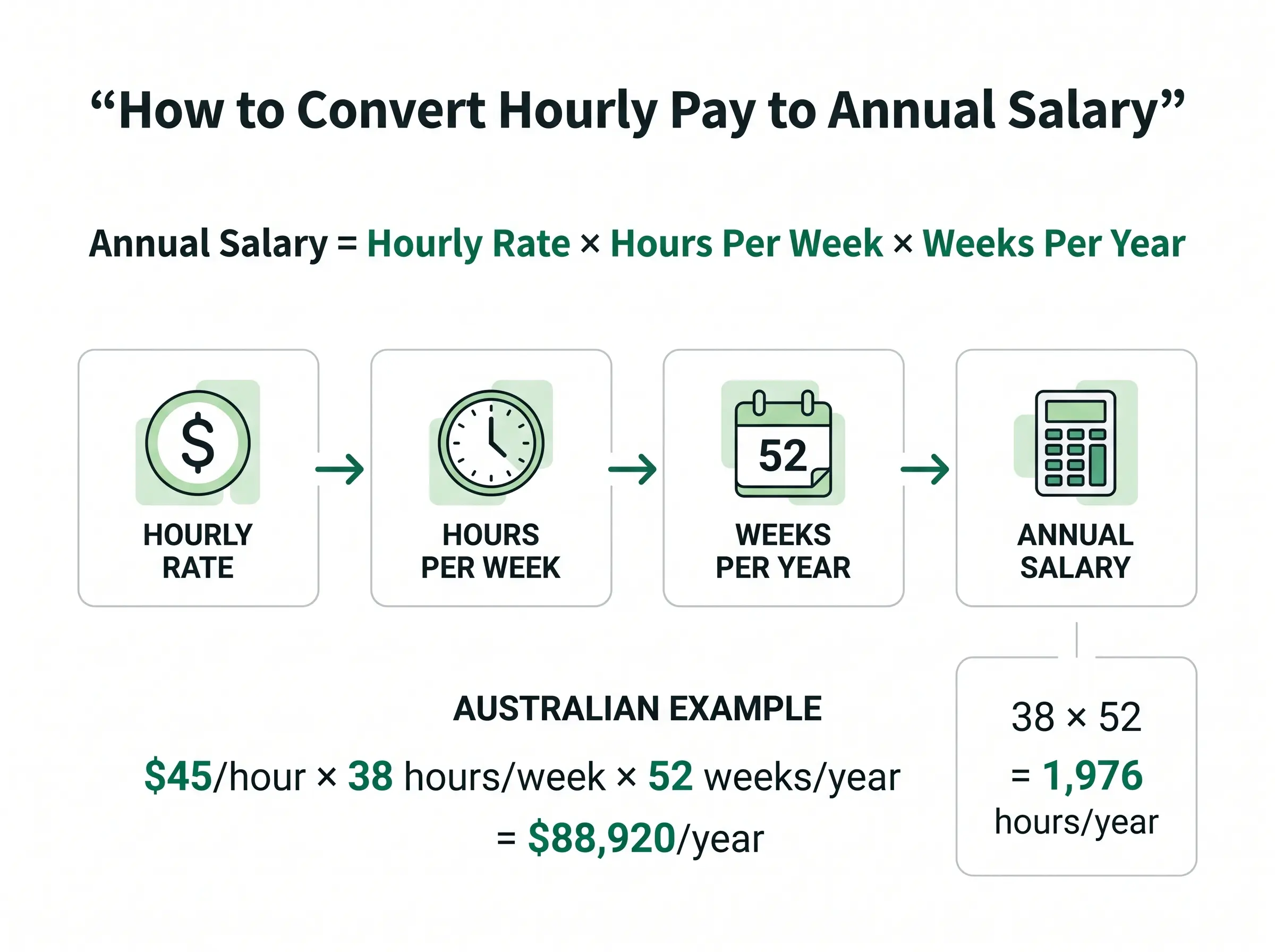
To convert an hourly rate to an annual salary, use this formula: annual salary equals hourly rate times hours per week times weeks per year. Full-time employees usually work an average of 38 ordinary hours a week, though ordinary hours can vary by award, agreement or job. Using 38 hours over 52 weeks, that is your hourly rate times 1,976.
So a rate of $45 an hour works out to $45 times 1,976, which is $88,920 a year. The calculator does this for you and also shows the weekly, fortnightly and monthly figures, so you never have to reach for the sums yourself.
Worked example: $45 an hour at 38 hours a week
At $45 an hour and 38 hours a week, you earn $1,710 in a week, $3,420 in a fortnight, and $88,920 across a full year. If you work fewer hours, the annual figure drops in proportion. At 30 hours a week, the same $45 rate is $70,200 a year, because you are paid for fewer hours.
How do I work out my hourly rate from a salary?
To go the other way, divide your annual salary by the hours you work in a year. For full-time work that is your salary divided by 1,976, which is 38 hours a week across 52 weeks.
A $70,000 salary divided by 1,976 is about $35.43 an hour. An $80,000 salary is about $40.49 an hour. This is the figure to know when a job is advertised as a salary but you want to compare it with an hourly role, or when you are quoting a rate for casual or contract work.
Daily, weekly and fortnightly pay from an hourly rate
Once your annual figure is set, the other cycles follow from it. Your weekly pay is the annual figure divided by 52. Your fortnightly pay is the annual divided by 26, which is the most common pay cycle in Australia. Your monthly pay is the annual divided by 12. Your daily pay depends on your own hours: it is your hourly rate times the hours you work in a day, or your annual figure divided by the days you actually work in a year, which is around 260 for a five-day week. The calculator shows all of these at once. A real payslip can still differ, for the reasons set out further down.
Common hourly rates as an annual salary
This table shows each hourly rate as a full-time annual salary, based on 38 hours a week over 52 weeks, before tax. These are gross figures, so your take-home pay is lower.
|
Hourly rate |
Annual salary (38 hours, 52 weeks) |
|---|---|
|
$20 |
$39,520 |
|
$25 |
$49,400 |
|
$30 |
$59,280 |
|
$35 |
$69,160 |
|
$40 |
$79,040 |
|
$45 |
$88,920 |
|
$50 |
$98,800 |
|
$60 |
$118,560 |
|
$70 |
$138,320 |
|
$80 |
$158,080 |
|
$100 |
$197,600 |
If your week is not 38 hours, scale the figure to your own hours in the calculator. The point of the table is to give you a quick sense of where a rate lands as a yearly salary.
How hours per week change your salary
Two people on the same hourly rate can end up with very different annual salaries, because the hours decide the total. The rate is only half the story.
Take $45 an hour. At 30 hours a week it is $70,200 a year. At 38 hours, a common full-time week, it is $88,920. At 40 hours it is $93,600. That is a $23,400 gap between part-time and a longer week, on the exact same rate. This is why the calculator asks for your hours per week, rather than assuming everyone works full time.
Here is the same $45 rate across common weekly hours, over 52 weeks.
|
Hours per week |
Annual salary at $45/hour |
|---|---|
|
20 |
$46,800 |
|
25 |
$58,500 |
|
30 |
$70,200 |
|
38 (full time) |
$88,920 |
|
40 |
$93,600 |
Why 52 weeks, not 48
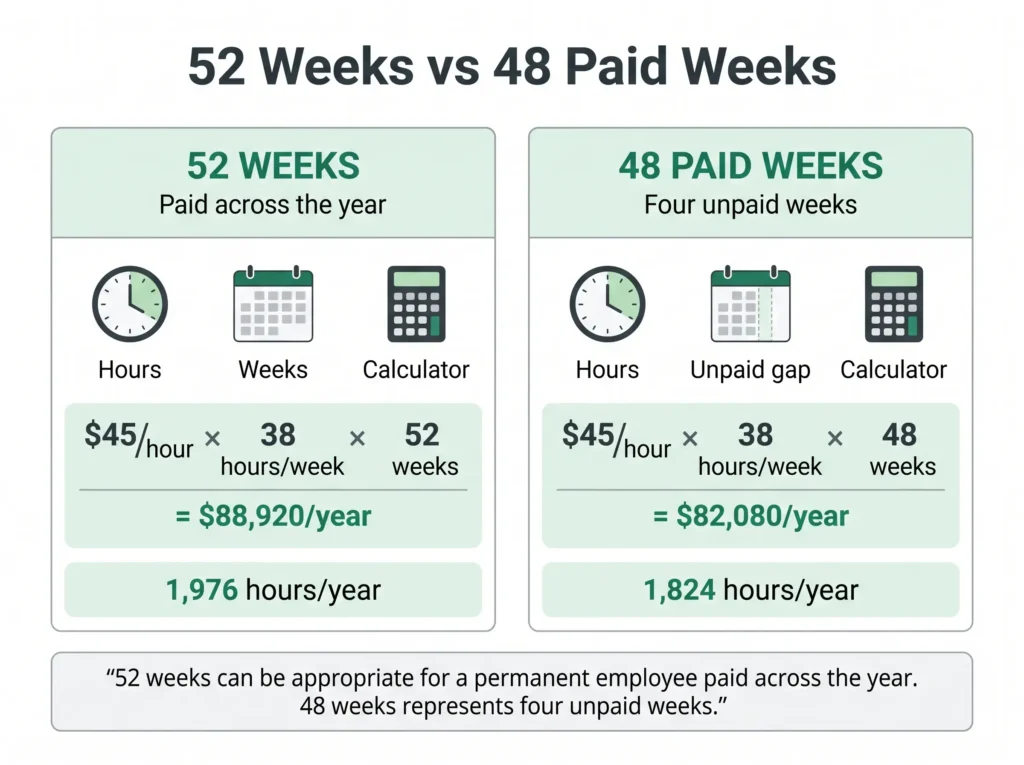
Most simple calculators multiply by 52 weeks, and so does this one by default. That assumes you are paid for the whole year, including your annual leave. Permanent employees in Australia get paid annual leave, usually four weeks a year, so their pay does not stop when they take a holiday. For them, 52 weeks is correct.
The picture changes for people who are not paid for time off. If you only get paid for the weeks you actually work, say 48 weeks with four unpaid weeks, your real annual figure is lower. In that case, change the weeks per year in the calculator to match. Spelling this out matters, because a calculator that quietly uses 52 weeks can make an unpaid or casual arrangement look better than it is.
What is $70,000 a year as an hourly rate?
A $70,000 salary is about $35.43 an hour for a full-time worker on 38 hours a week. Before tax, that is roughly $1,346 a week or $2,692 a fortnight.
After income tax and the Medicare levy, take-home on $70,000 is about $57,080 a year, which is close to $1,098 a week or $2,195 a fortnight, and works out to about $28.89 an hour in the hand. Switch on the after-tax view in the calculator to see this for your own salary.
What is $45 an hour annually in Australia?
At 38 hours a week, $45 an hour is $88,920 a year before tax, using the formula of hourly rate times 38 times 52. After income tax and the Medicare levy, that leaves about $69,946 in take-home pay for a resident under the calculator’s stated assumptions, or roughly $35.40 an hour once tax is taken out.
The same method works for any rate. $35 an hour is $69,160 a year, and $40 an hour is $79,040. How a rate compares depends on your industry, your experience and whether the role is casual or permanent, since a casual is paid a loading on top of the base rate but does not receive paid leave. The calculator shows the before-tax and after-tax figures for whatever rate you enter, at your own hours.
What does $45 an hour work out to in Australia?
At 38 hours a week, $45 an hour is $88,920 a year before tax. Under the calculator’s 2026-27 resident assumptions, it is about $69,946 after income tax and the Medicare levy.
Your actual result can change with your hours, tax circumstances, super arrangement and other deductions.
Your hourly rate before tax and after tax
The hourly rate you see in a job advertisement is usually a gross rate, the pay before tax comes out, but check whether super is included in the quoted amount. Your after-tax rate is lower because income tax and, where applicable, the Medicare levy reduce the amount you keep from your gross pay.
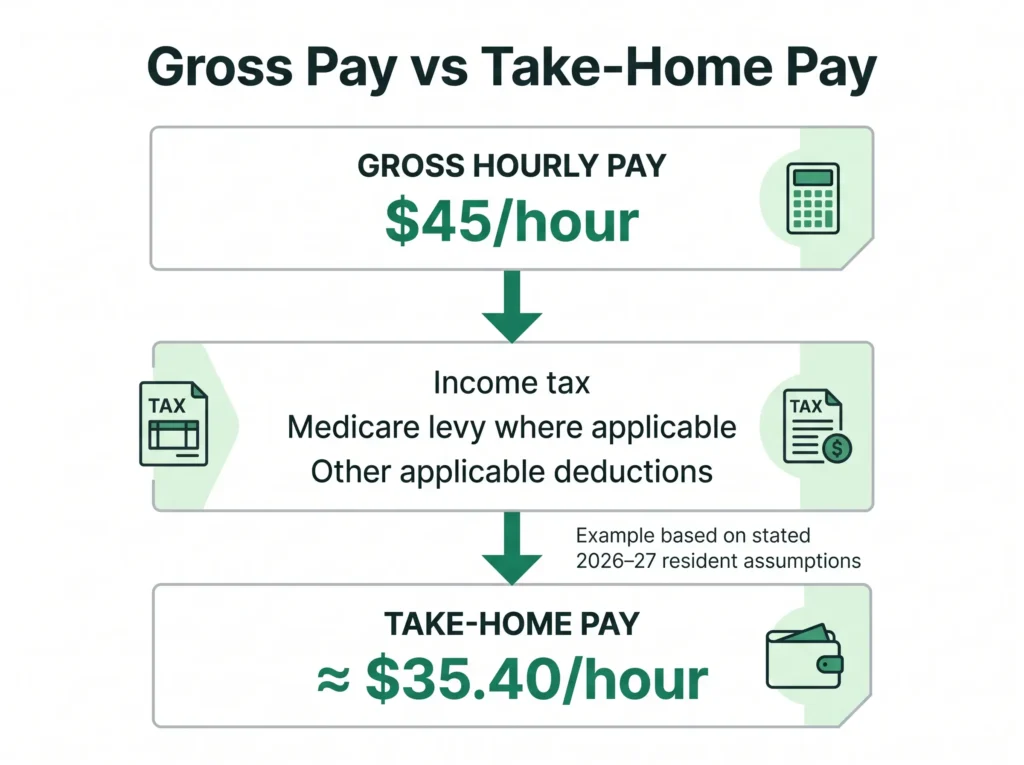
As a specific example, $40 an hour gross is close to $32 an hour in the hand, and $45 an hour gross is about $35.40 after tax, for a resident in 2026-27 with no study loan. Turn on the after-tax view and the calculator applies the current resident rates so you can see the figure for your own rate.
Common hourly rates after tax
Gross figures are useful, but take-home pay shows how much remains after the deductions included in the calculation. This table shows the full-time annual salary for each rate, the take-home pay after income tax and the Medicare levy, and the after-tax hourly rate. It uses the 2026-27 resident rates for a single person with no study loan.
|
Hourly rate |
Annual salary |
Take-home pay |
After-tax hourly |
|---|---|---|---|
|
$30 |
$59,280 |
$49,790 |
$25.20 |
|
$35 |
$69,160 |
$56,509 |
$28.60 |
|
$40 |
$79,040 |
$63,227 |
$32.00 |
|
$45 |
$88,920 |
$69,946 |
$35.40 |
|
$50 |
$98,800 |
$76,664 |
$38.80 |
|
$60 |
$118,560 |
$90,101 |
$45.60 |
The higher your rate, the larger the share that goes to tax, because more of your income falls into the higher brackets. That is why the after-tax hourly figure rises more slowly than the gross rate.
Does your hourly rate include super?
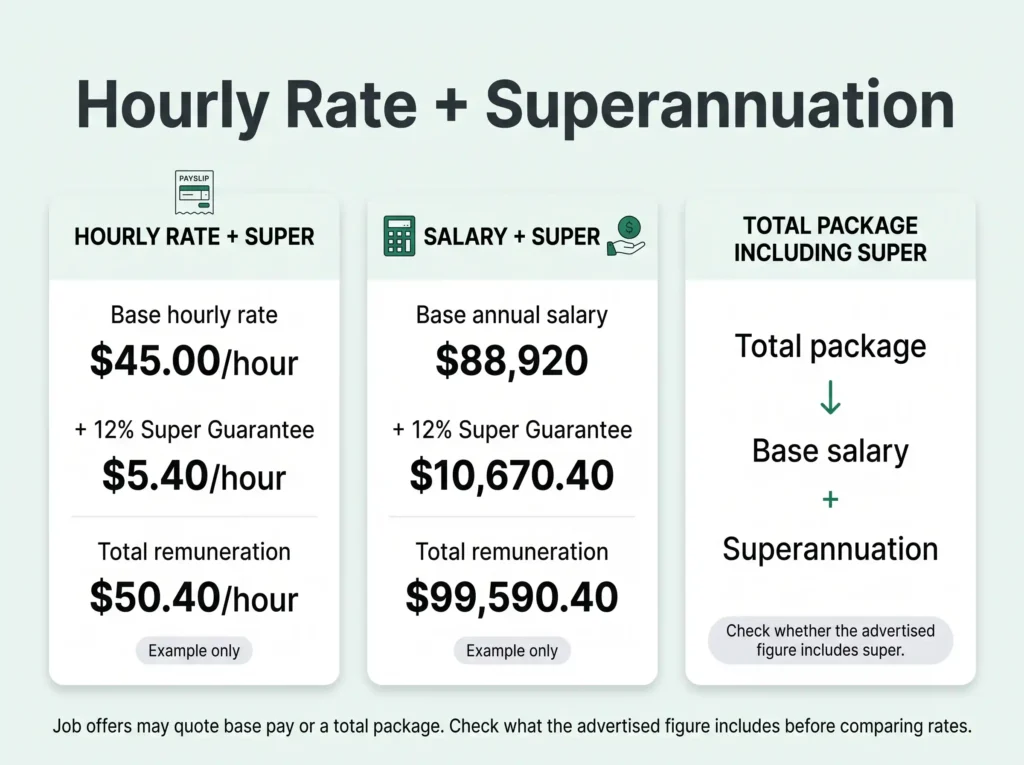
It depends on how the rate is quoted. Superannuation is generally an employer contribution paid on top of your base pay, not taken out of your hourly rate. For 2026-27 the Super Guarantee rate is 12 percent for eligible employees, subject to the applicable super rules. So an advertised rate does not automatically have 12 percent added on top: check whether the figure is a rate plus super or a package that already includes it.
The exception is a job advertised as a total remuneration package, where super is bundled into the headline figure. In that case the underlying base rate is lower than it looks. So there are three things to tell apart: an hourly rate plus super, a salary plus super, and a total package that already includes super. Check which one an offer means before you compare it.
Casual versus permanent: comparing the two
Casual and permanent pay cannot be compared rate for rate, because they include different things.
How casual loading works
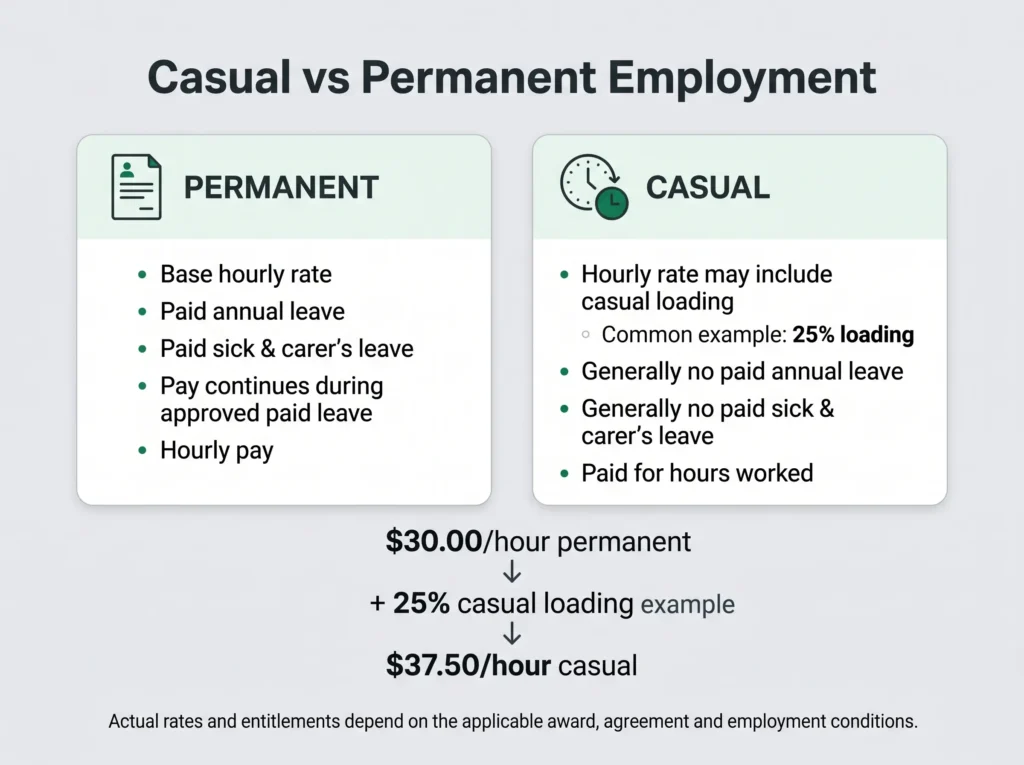
Casual employees are generally paid a loading, commonly 25 percent, on top of the base rate. It generally compensates eligible casual employees for certain entitlements they do not receive as casuals, such as paid annual leave and paid sick or carer’s leave. For eligible adult casuals on the National Minimum Wage, the rate from 1 July 2026 is $33.05 an hour, which is the $26.44 base plus the 25 percent loading. Many employees are covered by a modern award or agreement that can set a different or higher rate. The Fair Work Ombudsman publishes these rates.
Turning a casual rate into a permanent-equivalent salary
A casual rate looks higher per hour, but it has no paid leave built in. Two things matter when you compare. First, a casual is only paid for hours worked, so if they take time off, they earn nothing that week. Second, the loading is intended to compensate eligible casual employees for certain entitlements they generally do not receive, such as paid annual and sick or carer’s leave. So a casual on $33 an hour and a permanent worker on $26 an hour are not directly comparable once you account for four weeks of paid leave and public holidays. The calculator gives you the annual figure for each, which makes the annual cash amounts easier to compare.
Here is a worked comparison. A permanent worker on $30 an hour earns $59,280 a year and is paid across all 52 weeks, including four weeks of annual leave. A casual doing the same job gets the 25 percent loading, so about $37.50 an hour. If that casual works all 52 weeks, they earn $74,100, which is more in cash. But the casual does not receive paid annual leave or paid sick and carer’s leave, so if they take four weeks off they are unpaid for that time and earn about $68,400 instead. The cash outcome depends on the hours actually worked. Permanent employees generally receive paid leave entitlements, while casual employees generally do not. Compare the annual cash pay alongside the applicable conditions and entitlements before you decide.
Overtime, penalty rates and allowances
The calculator works on your ordinary rate. It does not add overtime, weekend penalty rates or allowances, because those depend on your award or agreement and vary by industry. Penalty rates can apply to weekends, public holidays and late shifts, and the exact amount is set by the award that covers your job. If your pay includes regular overtime or penalties, your real annual figure will be higher than the base conversion, and you can check your specific rates on the Fair Work website.
How to compare an hourly job offer with a salaried one
When you are weighing an hourly job against a salaried one, do not compare the rate against the salary directly. Put both on the same footing first.
Start by converting the hourly offer to an annual figure using the hours you would actually work. Then check whether each figure includes super or has it paid on top, because a salary quoted as a package can hide a lower base. Next, account for paid leave, since a permanent salary covers your holidays while a casual hourly rate does not, even though the casual rate is higher. Finally, compare the after-tax figures, because two roles with the same gross can leave you with different take-home pay if one carries a HECS repayment or the surcharge. Once both offers are annual, super-adjusted and after tax, you are comparing like with like.
What hourly rate do you need to match a salary?
If you are moving from a salaried job to hourly or casual work, you often want the hourly rate that matches your old salary. Divide the salary by your yearly hours. To match a $60,000 salary at 38 hours a week you need about $30.36 an hour, to match $80,000 about $40.49, and to match $100,000 about $50.61. If the new role is casual, the hourly rate may need to be higher to account for the paid leave and other entitlements that do not generally apply to casual employees. A rough guide is to add the 25 percent loading, so matching a $60,000 permanent salary as a casual means asking for closer to $38 an hour.
Who uses this calculator
This tool helps a wide range of Australian workers. Casual staff in retail and hospitality use it to see what their shifts add up to across a year. People weighing a job offer use it to compare an hourly role with a salaried one. Contractors and freelancers use it to set a rate that matches the salary they want. Part-time workers use it to see their pay at their real hours, not a full-time assumption. And anyone negotiating pay uses it to turn a target salary into the hourly rate they need to ask for.
At what hourly rate do you start paying income tax?
The tax-free threshold is $18,200 a year. At 38 hours a week over 52 weeks, you would reach that at about $9.21 an hour. Because of the Low Income Tax Offset, most residents pay no income tax until they earn around $22,867, which is close to $11.57 an hour full time.
Income tax, the Low Income Tax Offset and the Medicare levy are separate things. The tax-free threshold and LITO reduce your income tax, while the 2 percent Medicare levy has its own low-income thresholds, so paying little or no income tax does not automatically mean you pay no Medicare levy. In practice, every full-time worker on at least the minimum wage pays some income tax, because the minimum wage is well above these figures. The thresholds mostly matter for part-time and casual workers on fewer hours.
The minimum wage as an annual salary
From 1 July 2026, the national minimum wage in Australia is $26.44 an hour, or $1,004.90 a week for a 38-hour week, set by the Fair Work Commission’s 2026 Annual Wage Review. As a conversion of 38 hours over 52 weeks that is about $52,250 a year before tax, though Fair Work publishes the minimum as an hourly and weekly rate rather than an official annual salary. It is the first time the weekly minimum has passed $1,000.
Casual employees on the minimum get $33.05 an hour, which includes the 25 percent loading. Most workers are covered by a modern award, which can set a higher minimum than the national figure, so check your award on the Fair Work website. Eligible employees generally receive Super Guarantee contributions at 12 percent of their relevant earnings, on top of these figures, subject to the applicable super rules.
Younger workers and apprentices can be paid a percentage of the adult rate, set by their award or the National Minimum Wage Order, so a junior rate is lower. In fortnightly terms, the full-time adult minimum is about $2,009.80 before tax, and monthly it is about $4,354. A casual on the minimum of $33.05 an hour who works a 38-hour week earns $1,255.90 for that week, though casual hours often change from week to week.
Common mistakes when converting hourly to salary
A few simple errors throw the numbers off. Watch for these.
- Using 40 hours instead of 38. Full-time is usually an average of 38 ordinary hours a week under the National Employment Standards, not 40, though it can vary by award or agreement. Using 40 overstates the salary.
- Forgetting paid leave. Permanent workers are paid across 52 weeks including leave. Someone paid only for weeks worked should lower the weeks per year.
- Ignoring super. Super is on top of your pay, so do not subtract it from your rate or add it to your salary figure.
- Missing casual loading. A casual rate may include a casual loading, commonly 25%, so it should not be compared directly with a permanent salary without considering leave and other employment conditions.
- Comparing gross with net. Make sure you compare like with like, either both before tax or both after tax.
How to use this calculator
- Enter your pay and choose the unit: hour, day, week, fortnight, month or year.
- Set your hours per week, days per week and weeks per year to match your job.
- Read your pay converted into every cycle, with the annual salary shown up top.
- Tick “show after tax” to see the take-home version and your after-tax hourly rate.
Is this calculator accurate?
Yes, for the assumptions you set. The conversion uses your own hours per week, days per week and weeks per year, so it is only as accurate as those figures. The default is 38 hours and 52 weeks, the standard for a full-time permanent job.
The after-tax view applies the ATO 2026-27 resident rates, the tax-free threshold, the Low Income Tax Offset and the 2 percent Medicare levy. It is an estimate based on the assumptions you set, not a payslip. Your actual pay can differ because of payroll rounding, PAYG withholding settings, overtime, leave, salary sacrifice, a HECS or HELP repayment and other deductions. It does not include HECS, salary sacrifice or non-resident rates, so for those use the take-home pay calculator. See our methodology page for how each figure is worked out and when the rates were last checked.
Frequently asked questions
What is a standard working week in Australia? Full-time employees usually work an average of 38 ordinary hours a week under the National Employment Standards, though actual ordinary hours can vary by award or agreement. The calculator uses 38 hours by default to convert a full-time salary.
Should I include overtime in the conversion? Only if it is regular and guaranteed. The calculator uses your ordinary hours. If you reliably work paid overtime, add those hours, but leave them out if they change week to week.
How do I convert a part-time hourly rate to a full-time equivalent? Work out the annual figure at your part-time hours, then run the same rate at 38 hours to see the full-time equivalent. The rate stays the same, only the hours change.
Does my HECS or HELP debt affect this conversion? Not the gross conversion. A study loan is repaid through the tax system once your income passes $69,528 for 2026-27, so it lowers your take-home pay, not your salary figure. Use the take-home pay calculator to include it.
What is $27 an hour annually in Australia? At 38 hours a week, $27 an hour is about $53,352 a year before tax, which is just above the full-time minimum wage. After income tax and the Medicare levy the take-home is lower.
What is $80,000 a year as an hourly rate? About $40.49 an hour for a full-time worker on 38 hours a week. A $100,000 salary is about $50.61 an hour on the same basis.
What is $90,000 a year as an hourly rate? About $45.55 an hour for a full-time worker on 38 hours a week.
How much do I take home if I earn $70,000? About $57,080 a year after income tax and the Medicare levy, which is roughly $2,195 a fortnight or $1,098 a week.
How much is $70,000 a year every two weeks? Before tax it is about $2,692 a fortnight. After tax it is about $2,195, based on the 2026-27 resident rates.
What is $27 an hour as a salary in Australia? At 38 hours a week, $27 an hour is about $53,352 a year before tax, a little above the full-time minimum wage. After income tax and the Medicare levy your take-home is lower, which you can check in the calculator.
How many hours is full-time work in Australia? Full-time is usually an average of 38 ordinary hours a week under the National Employment Standards, though this can vary by award or agreement. That is the figure the calculator uses by default.
How many weeks are used to work out an annual salary? For a permanent worker, 52 weeks, because paid annual leave means you are paid all year. If you are only paid for the weeks you work, lower the weeks per year to match, for example 48 weeks with four unpaid.
How much is $100,000 a year per hour? About $50.61 an hour for a full-time worker on 38 hours a week over 52 weeks. After tax, the hourly figure in the hand is lower, which the calculator shows.
Sources and references
Every figure was checked in September 2026 against official Australian sources.
- Fair Work Ombudsman, National Minimum Wage and casual rates (fairwork.gov.au/pay-and-wages/minimum-wages)
- Australian Taxation Office, individual income tax rates (ato.gov.au)
- Australian Taxation Office, Medicare levy and the Super Guarantee rate (ato.gov.au)
- Australian Bureau of Statistics, Employee Earnings (abs.gov.au)
Reviewed by a registered tax agent
The rates and figures in this calculator were reviewed by James Wilson, CPA and registered Tax Agent with the Tax Practitioners Board, and Director of Australian Tax Advisors on the Gold Coast. The review covered the 2026-27 income tax, Medicare levy and superannuation figures, the hourly-to-salary conversion method and the assumptions used for the after-tax estimates, against current ATO rates. You can see James on LinkedIn.
Last reviewed by James Wilson, CPA, in September 2026.
Estimate only. This calculator provides general information and is not personal financial or tax advice. For advice about your own situation, speak with the ATO or a registered tax agent.