Pay Calculator Australia
See exactly what lands in your bank, every cycle.
Your take-home pay
that is $0 a fortnight, from $0 gross
| Period | Gross | Take-home |
|---|
Full breakdown
Estimate only, not financial advice. Rates verified against the ATO for 2026-27. Thresholds are indexed each July, so re-check then.
Updated for the 2026-27 financial year. Built on ATO formulas. Every figure was checked against the Australian Taxation Office in September 2026. Your numbers stay in your browser, and there is no sign-up.
Reviewed by James Wilson, CPA and registered Tax Agent (Australian Tax Advisors, Gold Coast). Last reviewed September 2026.
You earned the money. This tool shows you how much of it actually reaches your bank account.
Type in your salary or your hourly rate, choose how often you get paid, and you will see your take-home pay for the week, the fortnight, the month and the year. The pay calculator works out your income tax, the Medicare levy, your super and any HECS or HELP repayment, then shows you what is left. It handles Australian residents, foreign residents and people here on a working holiday visa.
Most Australians never see this full picture on a payslip. Your payslip shows one number. It does not always explain why that number is smaller than you expected, or how a pay rise, a second job or a study debt changes it. This page fills that gap.
Whether you call it a pay calculator or a salary calculator, Australia runs one federal tax system, so the rules are the same wherever you work. This pay calculator Australia edition applies the current 2026-27 rates to every worker. It suits employees, casuals, part-timers, contractors and anyone arriving on a visa who wants a clear answer before payday. If you searched for a salary calculator Australia workers trust, or a wage calculator that shows the real number, you are in the right place.
Your pay, broken down for every cycle
Once you enter your income, the calculator splits it into the four pay cycles Australians actually use.
Weekly, fortnightly, monthly and annual take-home pay
There are 52 weeks, 26 fortnights and 12 months in a year. The calculator divides your yearly take-home pay across each of these so you can plan a weekly budget or check a fortnightly payslip. If you are paid fortnightly, which is the most common pay cycle in Australia, that figure sits front and centre.
Where your money goes
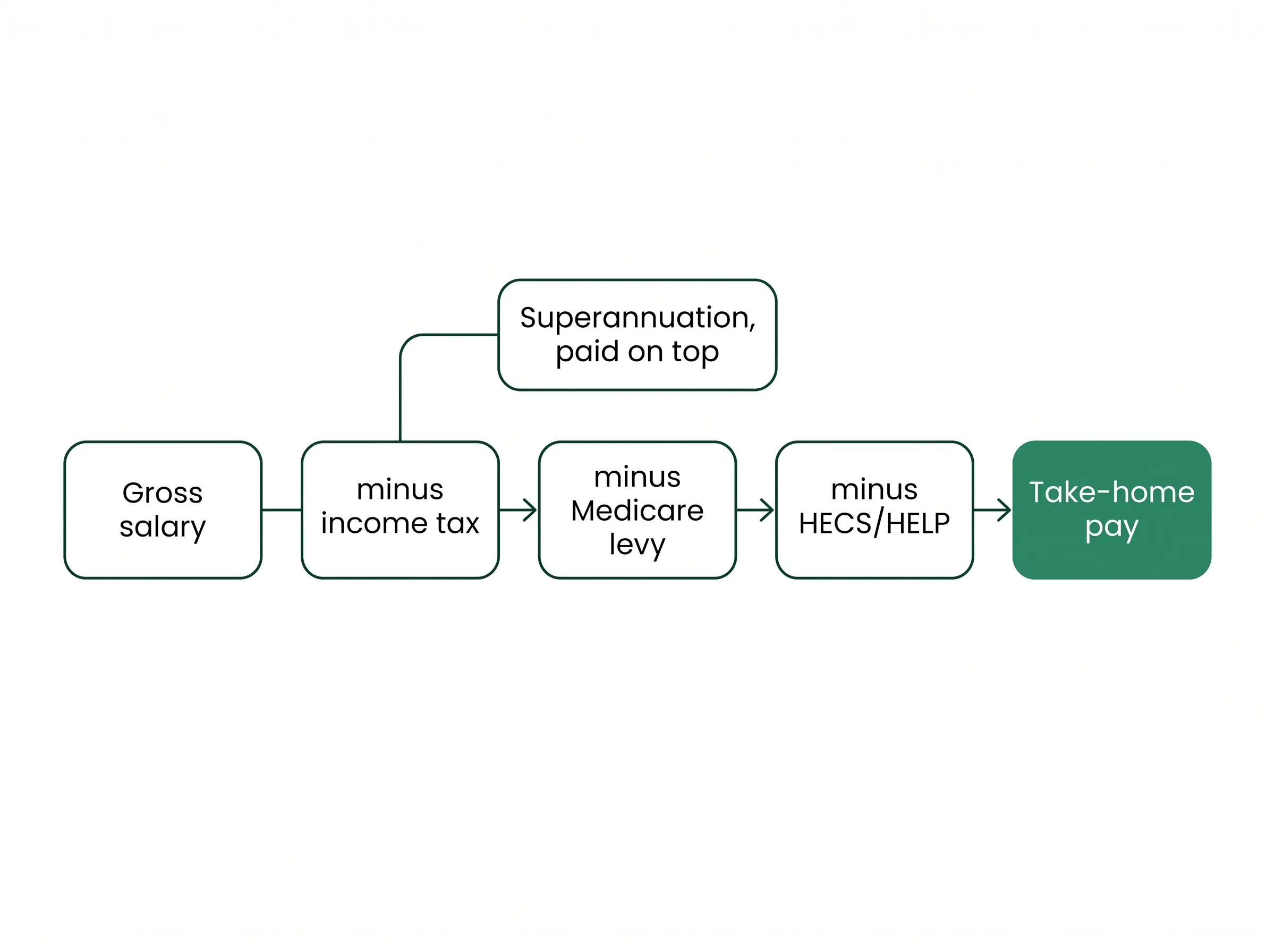
A simple split shows how your gross pay divides into tax, the Medicare levy, super and the amount you keep. Seeing it laid out makes it clear that tax and the levy are only part of the story, and that super sits on top rather than coming out of your pocket.
See how a pay rise really lands in your bank
This is the part that surprises people. When you earn more, only part of each extra dollar reaches you, because the top slice of your income is taxed at your marginal rate. The tool shows how much of a $1,000 rise you would actually keep. On a middle income that is often around $680 of every $1,000, with the rest going to tax and the Medicare levy. Knowing this stops the common shock of a raise that feels smaller than promised.
How is take-home pay calculated in Australia?
Take-home pay is your gross salary minus income tax, the Medicare levy and any compulsory HECS or HELP repayment. What is left is your net pay, the money that lands in your account.
The steps run in order. First, your employer works out your gross pay for the period. Then they apply the ATO tax tables to withhold income tax under the pay as you go system, known as PAYG. On top of that they take the 2 percent Medicare levy for most residents. If you have a study or training loan, a repayment comes out too. Super is calculated separately and paid into your fund, not deducted from your take-home pay. The final figure is your net pay.
The calculator follows the same order the ATO uses, so the result lines up with how your payslip is built.
Why your take-home pay might not match your payslip
If this tool and your payslip do not agree to the dollar, that is normal, and here is why. This is the single most common complaint people have about pay calculators, so it deserves a plain answer.
PAYG is an estimate, not your final tax.
Your employer withholds tax using the ATO weekly, fortnightly or monthly tables. Those tables are built to be close, not exact. Your real tax is settled when you lodge your return, which is why some people get a refund and others get a bill.
A second job with no tax-free threshold.
You can only claim the $18,200 tax-free threshold from one job. If your second employer taxes you without it, more tax comes out of that pay, and a calculator set to a single job will show less.
HECS and HELP withholding.
Employers often withhold a study loan amount across the year based on your expected income. The final repayment is worked out on your actual income at tax time, so the two can differ.
The 27th pay or 53rd week.
Some years have 27 fortnights or 53 weeks instead of the usual 26 or 52. When that happens, each pay is slightly smaller, and annual figures can look different from a simple weekly figure multiplied out.
Rounding and mid-year changes.
Tax tables round to whole dollars. And if your pay went up or down partway through the year, your average withholding will not match a single steady salary.
When you understand these five reasons, the gap stops being a mystery. The calculator gives you an accurate estimate for a full year at a steady income, which is exactly what you want for planning.
What comes out of your pay
Four things reduce your gross salary before it reaches you. Here is what each one is and how it works in 2026-27.
Income tax and how PAYG withholding works
Income tax is charged on your taxable income using marginal rates. Marginal means each rate applies only to the slice of income inside its bracket, not to your whole income. Your employer collects this tax gradually from each pay under the PAYG system and sends it to the ATO on your behalf. You do not pay it in one lump at the end of the year.
The Medicare levy
Most Australian residents pay a Medicare levy of 2 percent of their taxable income. This helps fund the public health system. Low income earners pay a reduced levy or none at all. For a single person in 2026-27, no levy applies below $28,011, a reduced amount applies between $28,011 and $35,014, and the full 2 percent applies above that.
The Medicare Levy Surcharge, and who actually pays it
This is a separate charge on top of the levy. It only applies to higher income earners who do not hold private hospital cover. Depending on income, it adds between 1 percent and 1.5 percent. Many people are surprised by it, or surprised they avoided it, so the calculator shows it as its own line rather than hiding it inside the levy. Taking out basic private hospital cover can remove it for people over the threshold.
HECS and HELP repayments and your pay
If you studied with a government loan, you repay it through the tax system once your income passes a threshold. For 2026-27 the first repayment threshold is $69,528. The system is now marginal, which means you only repay a percentage of the income above the threshold, not a percentage of your whole income. Tick the HECS box in the calculator to see the effect on your take-home pay.
How the Low Income Tax Offset lowers your tax
The Low Income Tax Offset, or LITO, is worth up to $700 for people earning up to $37,500, and it phases out by the time income reaches $66,667. It reduces the tax you pay rather than adding to your refund directly. Because of LITO, most residents do not pay any income tax until they earn around $22,867, even though the tax-free threshold is $18,200.
Australian income tax brackets for 2026-27
For the 2026-27 financial year, Australian residents pay no tax on the first $18,200, then 15 percent up to $45,000, 30 percent up to $135,000, 37 percent up to $190,000, and 45 percent above that.
Here is the full resident scale, which runs from 1 July 2026 to 30 June 2027. These figures do not include the 2 percent Medicare levy.
| Taxable income | Tax rate on that slice |
| $0 to $18,200 | 0 percent |
| $18,201 to $45,000 | 15 percent |
| $45,001 to $135,000 | 30 percent |
| $135,001 to $190,000 | 37 percent |
| $190,001 and over | 45 percent |
The 15 percent rate is new for this year. On 1 July 2026 the second bracket dropped from 16 percent to 15 percent under legislated cost of living tax cuts. For anyone earning $45,000 or more, that change is worth up to $268 a year. A further cut to 14 percent is already legislated for 1 July 2027.
Your marginal rate is the rate on your next dollar. Your effective rate is the average across all your income, and it is always lower than your marginal rate because the lower brackets tax part of your income at 0, 15 and 30 percent. The calculator shows both, so you can see the difference at a glance.
Gross pay versus net pay: what is the difference?
Gross pay is your income before anything is taken out. Net pay, also called take-home pay, is what is left after income tax, the Medicare levy and any study loan repayment. Super is separate and is added on top by your employer.
When a job ad quotes a salary, it is quoting gross pay. Your net pay is always lower, which is why the number in your account can feel like a surprise. This calculator turns one into the other for you.
How Australians get paid: weekly, fortnightly, monthly and hourly
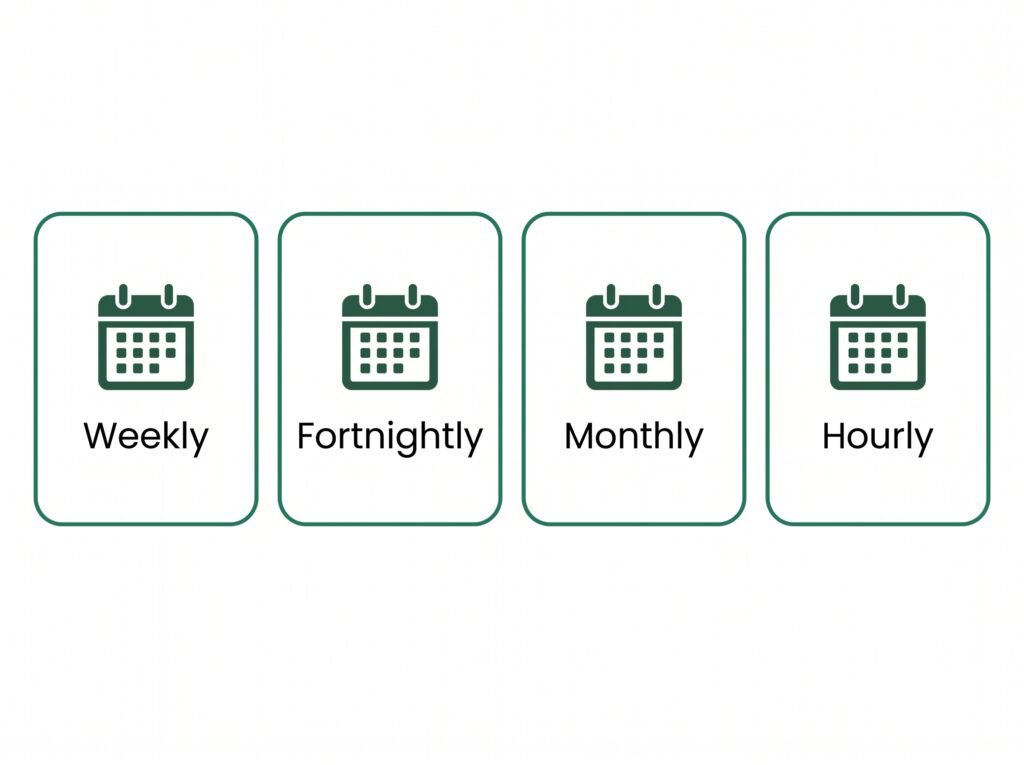
Australian workers are usually paid weekly, fortnightly or monthly, and casual and part-time staff are often paid by the hour. Fortnightly is the most common cycle.
Converting between them is straightforward, and the calculator does it instantly. To turn an annual salary into an hourly rate, divide it by your yearly hours, which for a standard 38 hour week is about 1,976 hours. To go the other way, multiply your hourly rate by your hours per week, then by 52. Enter your figure in any cycle and every other cycle updates.
One quirk worth knowing. Because a year is not a whole number of weeks, some years bring a 27th fortnight or 53rd payday. In those years each pay is a little smaller, so do not be alarmed if your weekly figure times 52 does not exactly match your annual salary.
Hourly, casual and shift pay
Pay for casual and shift workers has extra rules on top of the base rate, set by the relevant award or agreement.
How casual loading works
Casual employees usually receive a loading, commonly 25 percent, on top of the base hourly rate. This makes up for the paid leave and notice that permanent staff get and casuals do not. The Fair Work Ombudsman sets and explains these entitlements.
When penalty rates apply
Penalty rates are higher rates for hours worked at certain times, such as weekends, public holidays, evenings or overtime. The exact rate depends on your award or enterprise agreement, so there is no single figure that fits every worker. If you work in retail, hospitality or a similar award-covered role, check your specific award on the Fair Work website for the rates that apply to you.
Overtime and shift loading
Overtime is usually paid above your normal rate, often time and a half or double time, again depending on your award. Shift loadings apply to regular non-standard shifts. Because these vary so widely, a general pay calculator gives you the tax and take-home picture on your total earnings, while your award tells you the exact penalty and overtime rates.
Your tax residency changes your pay
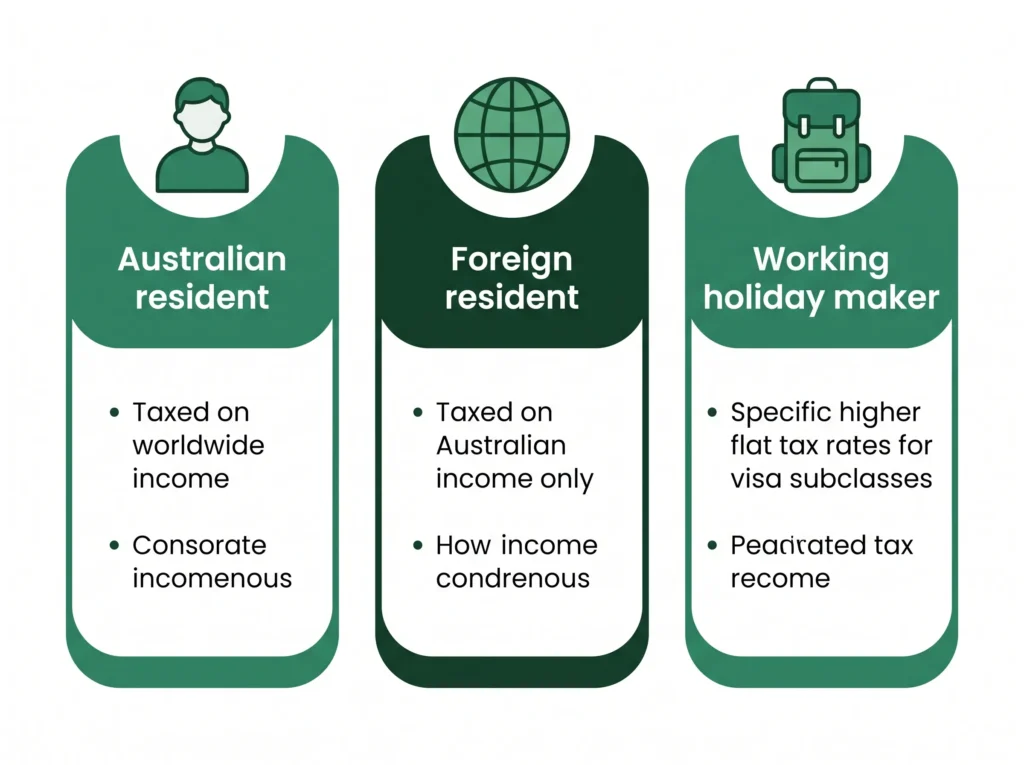
The single biggest factor people get wrong is residency. Residents, foreign residents and working holiday makers are taxed on completely different scales.

Australian residents
If you are an Australian resident for tax purposes, you get the $18,200 tax-free threshold and the resident rates shown above, and you pay the Medicare levy. Most people who live and work here full-time fall into this group.
Foreign residents
Foreign residents get no tax-free threshold. They pay 30 percent from the first dollar up to $135,000, then 37 percent to $190,000, and 45 percent above that. Foreign residents do not pay the Medicare levy, because they are not entitled to Medicare. Applying resident rates to a foreign resident is a common payroll error that leads to under-withholding and a tax bill later.
Working holiday makers on a 417 or 462 visa
If you are here on a working holiday visa, subclass 417 or 462, your first $45,000 is taxed at a flat 15 percent, with the standard scale applying above that. There is no tax-free threshold and no Medicare levy. If you have not given your employer a tax file number, they must withhold at 45 percent. This is the scale many backpackers are shocked by, so switch the residency setting to working holiday to see your real figure.
New migrants and visa holders
If you have recently moved to Australia, your residency for tax purposes depends on your circumstances, not just your visa. Many temporary residents are treated as residents once they settle here. The calculator lets you test each residency setting so you can see which numbers apply to your situation, and the ATO has a residency test if you are unsure.
Take-home pay on common salaries in 2026-27
Here is the full breakdown for a single Australian resident with private hospital cover and no study loan, using the verified 2026-27 rates. These are the same numbers the calculator above produces, so you can see exactly how each one is built.
Annual salary | Income tax | Medicare levy | Take-home per year | Take-home per fortnight | Super paid on top |
|---|---|---|---|---|---|
$60,000 | $8,420 | $1,200 | $50,380 | $1,938 | $7,200 |
$80,000 | $14,520 | $1,600 | $63,880 | $2,457 | $9,600 |
$100,000 | $20,520 | $2,000 | $77,480 | $2,980 | $12,000 |
$120,000 | $26,520 | $2,400 | $91,080 | $3,503 | $14,400 |
Worked example: take-home pay on $80,000
Take-home pay on an $80,000 salary is $63,880 a year, or about $2,457 a fortnight, for a single Australian resident in 2026-27. Here is how that number is built, step by step.
- The first $18,200 is tax free.
- The slice from $18,201 to $45,000 is taxed at 15 percent, which is $4,020.
- The slice from $45,001 to $80,000 is taxed at 30 percent, which is $10,500.
- Income tax comes to $14,520.
- The Medicare levy adds 2 percent of $80,000, which is $1,600.
- Total tax and levy is $16,120, so your take-home is $63,880.
- On top of that, your employer pays 12 percent super, which is $9,600 into your fund.
That is the exact working behind the figure, and you can reproduce it for any salary by changing the amount in the calculator.
For context, the Australian Bureau of Statistics reported average weekly ordinary time earnings for full-time adults of about $2,083 in May 2026, which works out to roughly $108,000 a year. The median full-time worker earns closer to $78,000, because a smaller group of high earners lifts the average. Earnings also vary by state, with Western Australia and the Australian Capital Territory at the top and Tasmania at the lower end. Your income tax, though, is federal, so it does not change based on which state you live in.
Enter your exact figure in the calculator for a precise result, and see the dedicated salary pages for a full breakdown of each amount.
Worked examples: how these take-home figures are built
Here is the full line-by-line breakdown for four common salaries, using the 2026-27 resident rates, for a single person with no study debt and with private hospital cover. These are the same numbers the calculator above produces.
Line item | $60,000 | $80,000 | $100,000 | $120,000 |
|---|---|---|---|---|
Gross salary | $60,000 | $80,000 | $100,000 | $120,000 |
Income tax | -$8,420 | -$14,520 | -$20,520 | -$26,520 |
Medicare levy (2 percent) | -$1,200 | -$1,600 | -$2,000 | -$2,400 |
Take-home pay per year | $50,380 | $63,880 | $77,480 | $91,080 |
Take-home per fortnight | $1,938 | $2,457 | $2,980 | $3,503 |
Super paid on top (12 percent) | $7,200 | $9,600 | $12,000 | $14,400 |
The $60,000 income tax figure already includes the $100 Low Income Tax Offset. Super is paid into your fund on top of these amounts, so it is not part of your take-home pay.
To show how the income tax is worked out, here is the $80,000 example step by step. The first $18,200 is tax-free. The next $26,800, from $18,201 to $45,000, is taxed at 15 percent, which is $4,020. The remaining $35,000, from $45,001 to $80,000, is taxed at 30 percent, which is $10,500. Added together, the income tax is $14,520. The Medicare levy adds 2 percent of $80,000, which is $1,600. So the take-home pay is $80,000 minus $14,520 minus $1,600, which is $63,880 a year, or about $2,457 a fortnight. On top of that, your employer pays $9,600 into your super.
Legal ways to increase your take-home pay
There are several genuine ways to keep more of what you earn. Each is worth exploring with the matching calculator or a registered tax agent.
- Salary sacrifice into super. Putting part of your pay into super before tax can lower your taxable income, within the concessional cap of $32,500 for 2026-27.
- A novated lease. Financing a car through your pay can reduce taxable income, though the maths depends on the car and your income.
- Claim your work deductions. Uniforms, tools, home office costs and work related travel can reduce your taxable income when you lodge. From 2026-27 a new standard deduction of up to $1,000 applies automatically for eligible employees.
- Private hospital cover. For higher earners, holding cover can remove the Medicare Levy Surcharge, which sometimes costs less than the surcharge itself.
- Voluntary HECS repayments. Extra repayments can reduce the interest-style indexation on your study loan.
- Salary packaging. Employees of some not-for-profit and health employers can package part of their pay for a tax benefit.
These are general points, not personal advice. Everyone’s situation differs, so check with the ATO or a registered tax agent before acting.
The most common pay calculation mistakes
People trip over the same handful of things. Avoid these and your estimate will be far closer to reality.
- Claiming the tax-free threshold on two jobs at once, which leads to a tax bill.
- Forgetting that super is usually on top of your salary, not inside it.
- Ignoring a HECS or HELP debt, which quietly reduces take-home pay.
- Using the wrong residency, especially for working holiday makers and new arrivals.
- Assuming penalty rates apply to everyone, when they depend on your award.
- Using last year’s tax rates after the 15 percent bracket change on 1 July 2026.
Which pay calculator should you use?
Different situations need different tools. Here is how to choose.
For employees
If you are a salaried or hourly employee, this main pay calculator covers you. For a single focus, use the take home pay calculator for your net figure, the income tax calculator to see tax alone, or the hourly rate calculator to convert between hourly and annual pay.
For contractors, ABN holders and employers
If you work under an ABN as a contractor or sole trader, the contractor calculator accounts for the fact that you handle your own tax and often your own super. Employers working out the full cost of a role can use the employer and super tools. Each links from this page so you can move to the right one in a click.
How to use this pay calculator
Getting your result takes a few seconds.
- Enter your income and choose whether it is annual, monthly, fortnightly, weekly, daily or hourly.
- Set your residency: Australian resident, foreign resident or working holiday maker.
- Tick any boxes that apply, such as includes super, HECS or HELP debt, or private hospital cover.
- Read your take-home pay across every cycle, with a full breakdown of tax, the levy and super.
Is this pay calculator accurate?
Yes, for a full year at a steady income. The calculator applies the ATO’s published 2026-27 rates and formulas: the resident, foreign resident and working holiday scales, the tax-free threshold, the Low Income Tax Offset, the 2 percent Medicare levy with its low-income shade-in, the 12 percent Superannuation Guarantee and the HECS and HELP repayment thresholds.
It gives an estimate, not a payslip or a tax return. It does not know your exact allowances, salary sacrifice arrangement or mid-year pay changes, and it does not replace advice from the ATO or a registered tax agent. For how each figure is worked out and when the rates were last checked, see our methodology page. We verify every rate against the ATO at the start of each financial year and whenever the government changes the rules.
Frequently asked questions
How often should my employer pay super?
From 1 July 2026, under Payday Super, employers must pay your Superannuation Guarantee at the same time as your regular pay rather than quarterly. You can check your contributions through your myGov account linked to the ATO.
How do I find my tax file number?
Your TFN is on your income statement, a previous notice of assessment or in your myGov account linked to the ATO. If you have lost it, you can phone the ATO to recover it. Never share your TFN by email or with anyone who is not your employer, your super fund or the ATO.
How do I find lost or unclaimed super?
Log in to myGov, link the ATO service, and use the super section to see all your accounts, including any the ATO is holding. Combining funds can save you paying multiple sets of fees.
Are my inputs stored?
No. The calculator runs in your browser and does not save or send your salary anywhere. Nothing you type is stored on our servers.
How do I work out my daily rate from an annual salary?
Divide your annual salary by the number of days you work in a year. For a standard five-day week that is about 260 working days, so a $78,000 salary is roughly $300 a day before tax.
Will I get a tax cut in 2026-27?
If you earn more than $45,000, yes. The second tax bracket fell from 16 percent to 15 percent on 1 July 2026, worth up to $268 a year, and it is applied automatically through your PAYG withholding.
What happens to my take-home pay if my income changes during the year?
Your average tax for the year is based on your total income, so a mid-year raise or a period of lower pay can make your withholding sit a little high or low. It usually balances out when you lodge your return.
How is a second job taxed?
You claim the tax-free threshold from one job only. Your second job is taxed from the first dollar at your marginal rate, so more tax comes out of it. This is correct, not a penalty, and it prevents a bill at tax time.
Is it better to be paid weekly, fortnightly or monthly?
Your total pay and total tax for the year are the same no matter which cycle you are on. The only difference is timing and budgeting. Weekly pay smooths out your cash flow, while monthly pay means fewer, larger deposits. Fortnightly, the most common cycle in Australia, sits in between. Enter your income once and the pay calculator shows every cycle side by side.
What deductions come out of my pay before it reaches my bank?
For most employees, three things: income tax through PAYG withholding, the 2 percent Medicare levy, and any compulsory HECS or HELP repayment. Super is not a deduction from your take-home pay, because your employer pays it on top. Higher earners without private hospital cover may also see the Medicare Levy Surcharge. This salary calculator shows each line separately so nothing is hidden.
Does an $80,000 salary include super?
Usually no. If a role is advertised as “$80,000 plus super,” your employer pays 12 percent super, or $9,600, on top. If it is a “total package,” super is included in the $80,000 and your base salary is lower. Tick the includes super box to see the difference for your own figure.
Sources and references
Every figure on this page was checked in September 2026 against official Australian sources.
- Australian Taxation Office, tax rates for Australian residents: ato.gov.au
- Australian Taxation Office, Schedule 15 tax table for working holiday makers: ato.gov.au
- Australian Taxation Office, Superannuation Guarantee and Payday Super
- Fair Work Ombudsman, casual loading, penalty rates and awards: fairwork.gov.au
- Australian Bureau of Statistics, Average Weekly Earnings, Australia: abs.gov.au
- ASIC Moneysmart, income tax and super guidance: moneysmart.gov.au
Reviewed by a registered tax agent
The tax rules and 2026-27 figures in this pay calculator were reviewed by James Wilson, CPA and registered Tax Agent with the Tax Practitioners Board, and Director of Australian Tax Advisors on the Gold Coast, Queensland. The review covered the income tax brackets, the Medicare levy, superannuation and HELP repayment amounts, checked against current ATO rates. You can see James on LinkedIn.
Last reviewed by James Wilson, CPA, in September 2026.
Estimate only. This pay calculator provides general information and is not personal financial or tax advice. For advice about your own situation, speak with the ATO or a registered tax agent.