Take Home Pay Calculator Australia
See exactly how much of your pay you keep after tax, with every deduction shown.
Your take home pay
that is $0 a fortnight, from $0 gross
| Period | Gross | Take-home |
|---|
Show tax bracket breakdown
Estimate only, not financial advice. Rates verified against the ATO for 2026-27. Thresholds are indexed each July, so re-check then.
Your pay, from gross to net
The point of this page is one number: your net pay, the amount left after everything comes out. The calculator does not just show that number, it shows the full path to it.
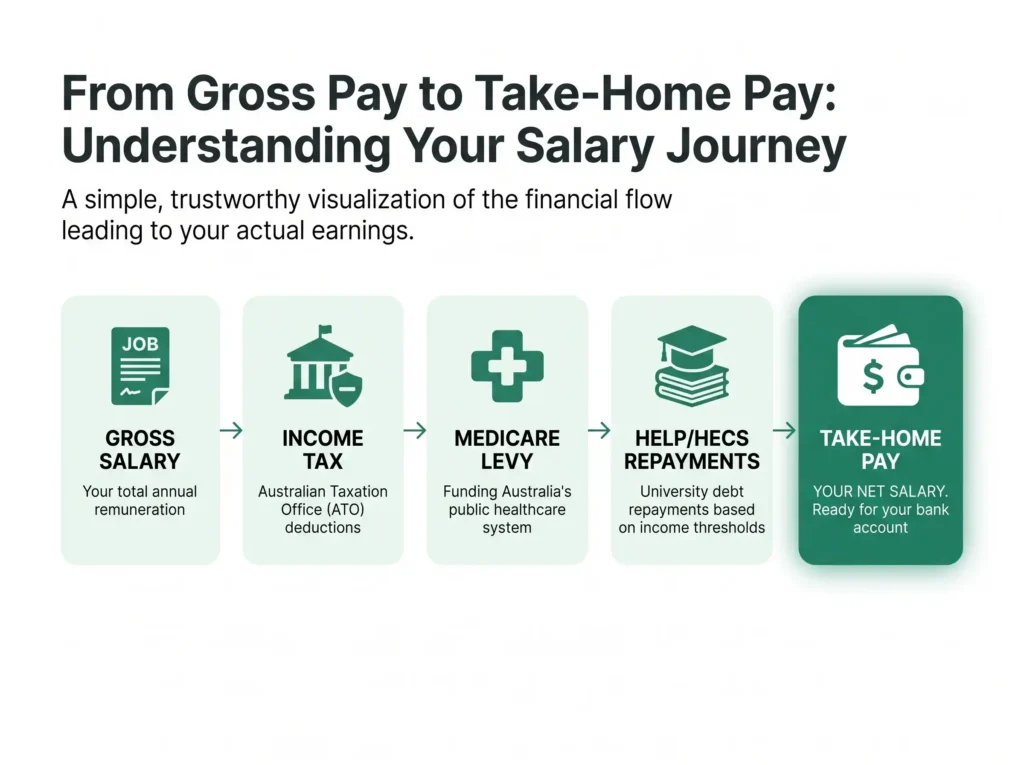
Where your pay goes
Your gross salary is the starting figure. From it, the calculator takes income tax, then the 2 percent Medicare levy, then any HELP or HECS repayment. What is left is your net pay, the amount you actually keep. Superannuation sits to one side, because your employer pays it on top of your salary rather than deducting it. Seeing each line makes it clear which parts you lose to tax and which you keep.
Your take home pay across every cycle
The same net figure is split into weekly, fortnightly, monthly and annual amounts, plus an hourly rate. Fortnightly is the most common pay cycle in Australia, so that row is the one most people check against their payslip. You can enter your pay in any cycle and the rest update straight away.
How much of your pay you keep
The calculator also shows your effective tax rate, which is the share of your whole income that goes to tax and the levy. It is always lower than your marginal rate, because your first $18,200 is tax free and the lower brackets are taxed at 15 and 30 percent before the higher rates apply.
How is take home pay calculated in Australia?
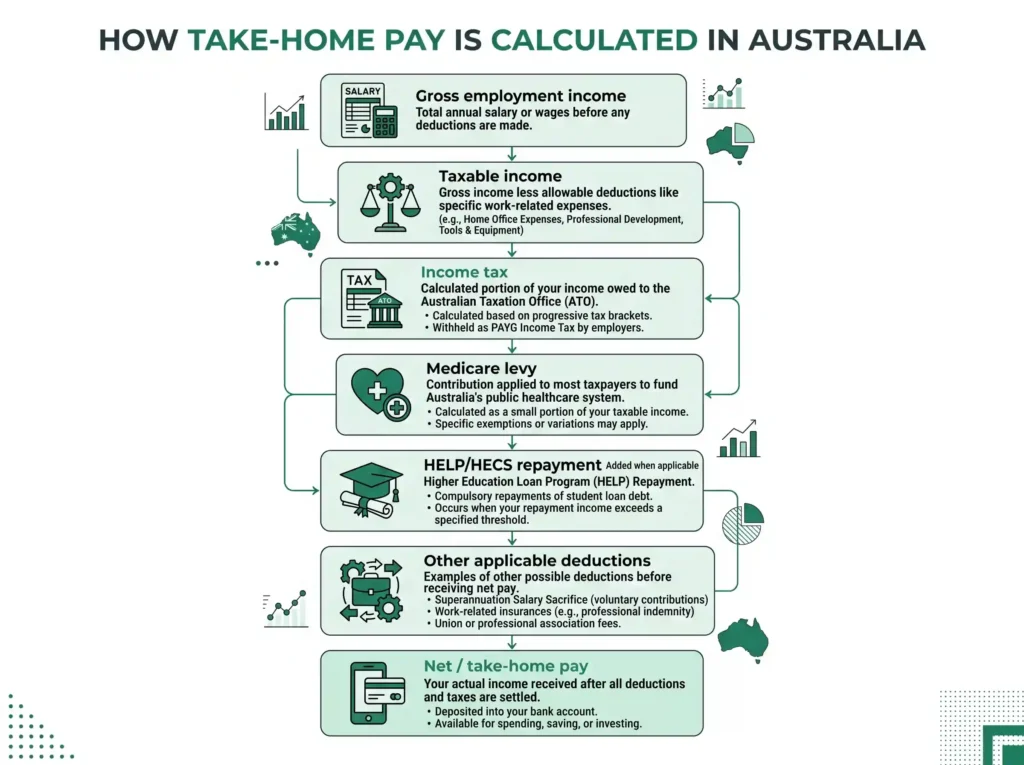
Take home pay is your gross salary minus PAYG income tax, the 2 percent Medicare levy and any compulsory HELP or HECS repayment. Super is added by your employer on top, so it does not reduce your net pay.
Your employer works out the tax to hold back each pay using the ATO tax tables, sends it to the Australian Taxation Office on your behalf, and pays you the rest. Your final tax is settled when you lodge your return, so the calculator gives you an accurate estimate for a full year at a steady income.
Why your take home pay is lower than you expected
If your payslip and this calculator do not match to the dollar, that is normal. It is the most common question people have about pay calculators, so here is the plain reason, in five parts.
First, PAYG is an estimate. The ATO tables are built to be close, not exact, which is why some people get a refund and others get a bill at tax time. Second, a second job is taxed harder, because you can only claim the $18,200 tax-free threshold from one employer. Third, a HELP or HECS repayment is withheld across the year based on your expected income, then trued up on your actual income when you lodge. Fourth, some years have 27 fortnights or 53 weeks instead of 26 or 52, which makes each pay slightly smaller. Fifth, tax tables round to whole dollars, and any mid-year pay change shifts your average.
Once you know these five reasons, the gap stops being a mystery.
What gets deducted from your pay
Income tax (PAYG withholding)
Income tax is charged on your taxable income at marginal rates, meaning each rate applies only to the slice of income inside its bracket. Your employer collects it gradually through the pay as you go system.
Medicare levy
Most Australian residents pay a Medicare levy of 2 percent of taxable income. A reduced levy or none applies to low income earners. For a single person in 2026-27, no levy applies below $28,011, and the full 2 percent applies above $35,014.
Medicare Levy Surcharge
This is a separate charge of 1 to 1.5 percent for higher earners who do not hold private hospital cover. The calculator shows it as its own line, and taking out basic hospital cover can remove it for people over the threshold.
HELP and HECS repayments
If you have a study loan, you repay it through the tax system once your income passes $69,528 for 2026-27. The system is marginal, so you repay a percentage only of the income above the threshold. Tick the HECS box to see the effect on your net pay.
Low Income Tax Offset (LITO)
LITO is worth up to $700 for people earning up to $37,500 and phases out by $66,667. It reduces the tax you pay, which is why most residents pay no income tax until they earn around $22,867.
Gross pay versus net pay: what is the difference?
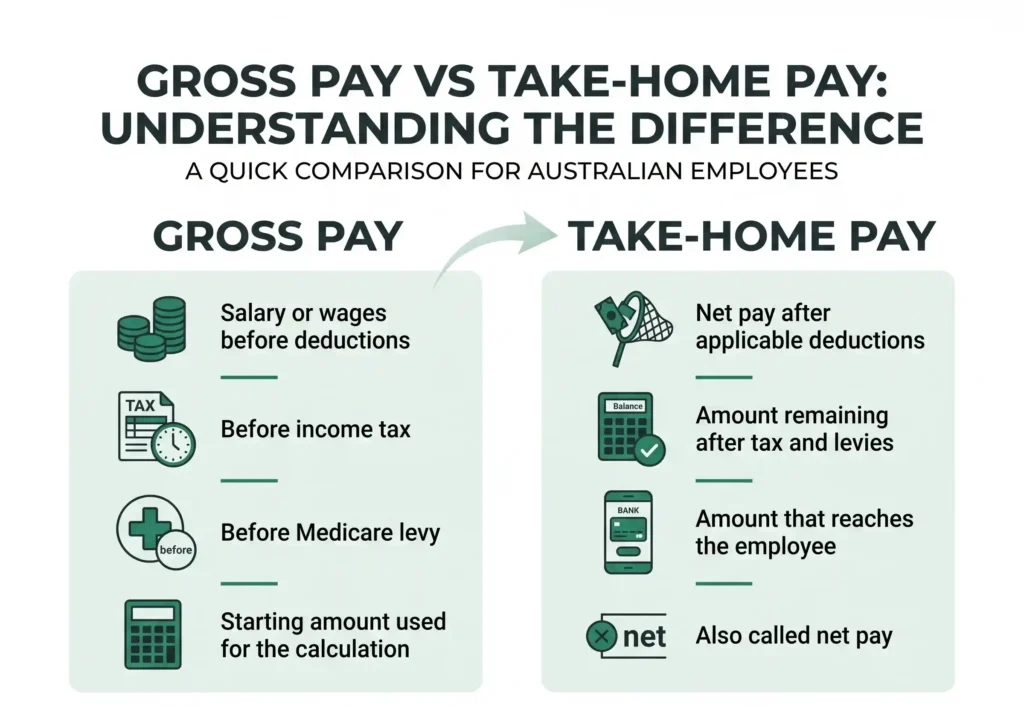
Gross pay is your income before anything is taken out. Net pay, also called take home pay, is what is left after income tax, the Medicare levy and any study loan repayment. A job ad always quotes gross pay, so your net figure is lower, which is why the number in your account can surprise you.
Does superannuation come out of your take home pay?
No. Your employer pays the superannuation guarantee, 12 percent for 2026-27, on top of your salary and into your fund. It is not deducted from your net pay. The one exception is a total remuneration package, where super is bundled into the headline figure. If your offer works that way, tick “includes super” and the calculator pulls the super back out before it works out your tax.
Take home pay on common salaries in 2026-27
Here is the net pay for a single Australian resident with private hospital cover and no study loan, using the verified 2026-27 rates. These match the calculator above.
|
Annual salary |
Income tax |
Medicare levy |
Take-home per year |
Take-home per fortnight |
Super on top |
|---|---|---|---|---|---|
|
$60,000 |
$8,420 |
$1,200 |
$50,380 |
$1,938 |
$7,200 |
|
$70,000 |
$11,520 |
$1,400 |
$57,080 |
$2,195 |
$8,400 |
|
$75,000 |
$13,020 |
$1,500 |
$60,480 |
$2,326 |
$9,000 |
|
$80,000 |
$14,520 |
$1,600 |
$63,880 |
$2,457 |
$9,600 |
|
$100,000 |
$20,520 |
$2,000 |
$77,480 |
$2,980 |
$12,000 |
|
$120,000 |
$26,520 |
$2,400 |
$91,080 |
$3,503 |
$14,400 |
Net pay on $75,000 is $60,480 a year, or about $2,326 a fortnight. On $70,000 it is $57,080 a year, or about $2,195 a fortnight. Enter your exact figure for a precise result.
How your take home pay compares at different salaries
According to the Australian Bureau of Statistics, average full-time ordinary earnings were about $2,083 a week in May 2026, which is roughly $108,000 a year. The median full-time worker earns closer to $78,000, because a smaller group of high earners lifts the average. So a salary of $75,000 sits near the middle for a full-time worker, a solid single income that is below the average but around the median.
How your residency changes your net pay
Australian residents
Residents get the $18,200 tax-free threshold, the resident rates, and pay the Medicare levy. Most people who live and work here full time are in this group.
Foreign residents
Foreign residents get no tax-free threshold and pay 30 percent from the first dollar up to $135,000. They do not pay the Medicare levy. So their net pay is lower on the same salary than a resident’s.
Working holiday makers
On a 417 or 462 visa, your first $45,000 is taxed at a flat 15 percent, with no tax-free threshold and no Medicare levy. Switch the residency setting to working holiday to see your real net figure.
Does your take home pay change by state?
No. Income tax in Australia is federal, so your net pay is the same whether you work in Sydney, Perth or regional Queensland. A search for a pay calculator by state returns the same net result everywhere. What can differ by state is your gross pay through awards and enterprise agreements, not the tax on it.
How to use this calculator
- Enter your income and choose annual, monthly, fortnightly, weekly, daily or hourly.
- Set your residency: Australian resident, foreign resident or working holiday maker.
- Tick includes super, HECS or HELP, or private cover if they apply.
- Read your net pay across every cycle, with the full gross-to-net breakdown.
Is this calculator accurate?
Yes, for a full year at a steady income. It applies the ATO 2026-27 rates and formulas: the resident, foreign resident and working holiday scales, the tax-free threshold, LITO, the 2 percent Medicare levy, the 12 percent super guarantee and the HELP repayment thresholds. It gives an estimate, not a payslip or a tax return, and it does not replace advice from the ATO or a registered tax agent. See our methodology page for how each figure is worked out and when the rates were last checked.
Frequently asked questions
How much tax do I pay on $4,000 a week? That is about $208,000 a year. Enter $4,000 per week in the calculator to see the exact tax and net pay, since that income reaches the top 45 percent bracket.
How much tax do I pay on $2,500 a fortnight? That works out to about $65,000 a year. Enter it as a fortnightly amount and the calculator shows the tax, the levy and your take-home for each cycle.
What is $40 an hour as an annual salary? At 38 hours a week, $40 an hour is about $79,000 a year before tax. Your take-home depends on your residency and any study loan.
What is $70,000 a year as an hourly rate? About $35.43 an hour, based on a 38 hour week over 52 weeks.
How is a second job taxed? You claim the tax-free threshold from one job only, so your second job is taxed from the first dollar at your marginal rate. More tax comes out of it, which prevents a bill at tax time.
Does private hospital cover change my take home pay? It can. Higher earners without cover pay the Medicare Levy Surcharge, so taking out basic hospital cover can lift their net pay. Tick “private cover” to compare.
What happens if my income changes during the year? Your average tax for the year is based on your total income, so a mid-year raise or a quiet period can make your withholding sit a little high or low. It usually balances out when you lodge.
Are my inputs stored? No. The calculator runs in your browser and does not save or send your salary anywhere.
Sources and references
Every figure was checked in September 2026 against official Australian sources.
- Australian Taxation Office, tax rates, Medicare levy, HELP and super: ato.gov.au
- Fair Work Ombudsman, awards and penalty rates: fairwork.gov.au
- Australian Bureau of Statistics, Average Weekly Earnings: abs.gov.au
Reviewed by a registered tax agent
The tax rules and 2026-27 figures in this calculator were reviewed by James Wilson, CPA and registered Tax Agent with the Tax Practitioners Board, and Director of Australian Tax Advisors on the Gold Coast. The review covered the income tax brackets, the Medicare levy, superannuation and HELP amounts against current ATO rates. You can see James on LinkedIn.
Last reviewed by James Wilson, CPA, in September 2026.
Estimate only. This calculator provides general information and is not personal financial or tax advice. For advice about your own situation, speak with the ATO or a registered tax agent.