HECS Repayment Calculator Australia
See your compulsory HECS or HELP repayment on the 2026-27 marginal system.
Compulsory HECS repayment a year
that is $0, on repayment income of $0
HECS repayment by pay cycle
| Period | Income | HECS repayment |
|---|
How your repayment is worked out
Worked out on repayment income (taxable income plus salary sacrifice, reportable fringe benefits and investment losses), not your debt size. Withheld from pay as STSL and applied when you lodge. Rates verified against the ATO for 2026-27.
This HECS repayment calculator works out your compulsory HECS or HELP repayment for the 2026-27 financial year, using the ATO’s current marginal system. Enter your income and it shows your repayment for the year, and what comes out of each pay, weekly, fortnightly or monthly. It was reviewed by James Wilson, CPA and registered Tax Agent.
How is HECS repayment calculated in Australia?
For 2026-27, you start repaying your HECS or HELP debt once your income passes $69,528. The repayment is worked out on a marginal system, which means you only repay a set percentage of the income above the threshold, not your whole income. The first rate is 15 cents for each dollar over $69,528.
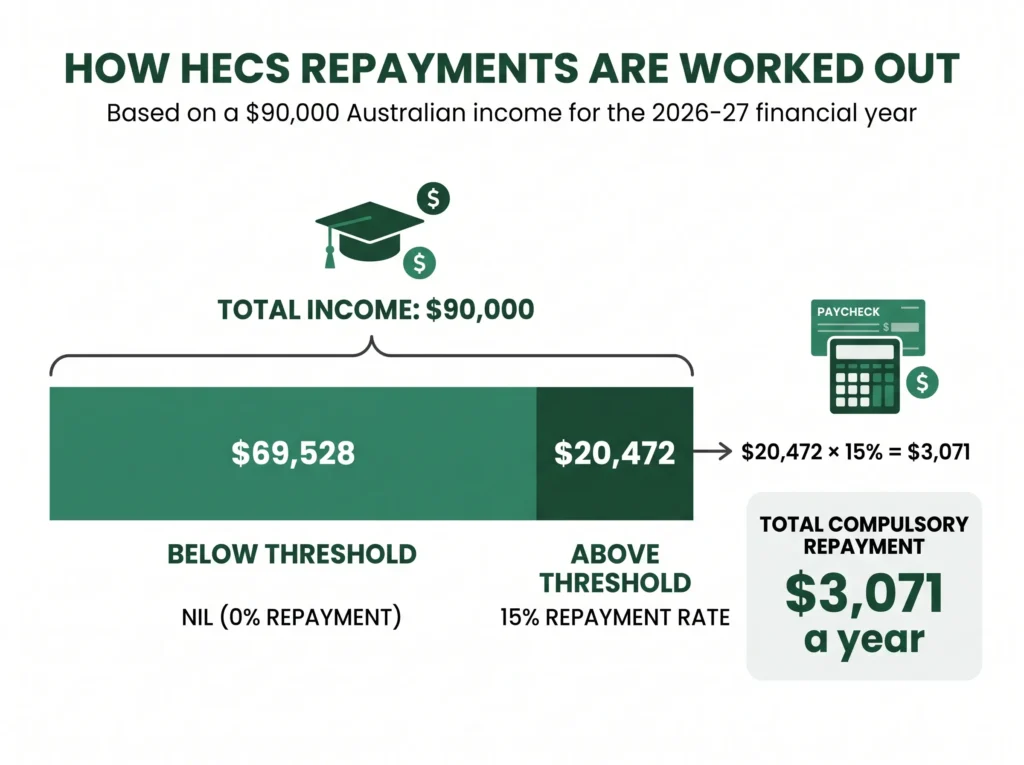
So on a $90,000 income, your repayment is 15 percent of the $20,472 that sits above the threshold, which comes to about $3,071 for the year. Your repayment depends on your income, not on how large your debt is, so two people on the same salary repay the same amount even if one owes $5,000 and the other owes $50,000. The calculator above does this for your own income and splits it across each pay cycle.
HECS repayment thresholds and rates for 2026-27
These are the repayment rates for the 2026-27 financial year, which runs from 1 July 2026 to 30 June 2027. The same thresholds and rates apply to HECS-HELP and every other study and training loan.
Repayment income | Rate | How it is worked out |
|---|---|---|
$0 to $69,528 | Nil | No compulsory repayment |
$69,529 to $129,717 | 15% | 15c for each $1 over $69,528 |
$129,718 to $186,050 | 17% | $9,028 plus 17c for each $1 over $129,717 |
$186,051 and over | 10% | 10% of your total repayment income |
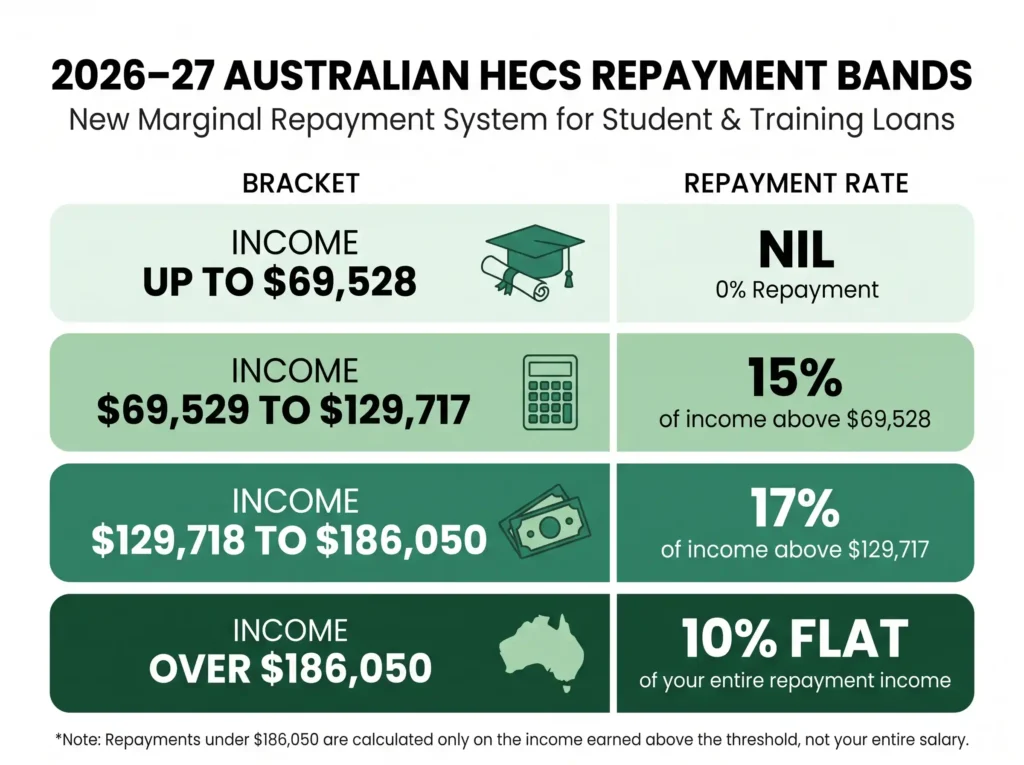
The threshold rose from $67,000 in 2025-26 to $69,528 for 2026-27, after the 2.8 percent indexation applied in 2026. For comparison, the 2025-26 first threshold was $67,000, and before the marginal system began it was only $54,435, so the starting point has moved up a long way in two years.
The top band works differently from the others. Once your income passes $186,050, the repayment becomes a flat 10 percent of your whole repayment income rather than a marginal slice, because at that level the flat result is the lower of the two. For almost everyone, though, the 15 percent first band is the one that applies.
What loans does this calculator cover?
The ATO uses one set of repayment thresholds and rates for all study and training loans, so this HECS repayment calculator works whichever type you hold. That includes HECS-HELP for your course fees, FEE-HELP for full-fee places, OS-HELP for overseas study, SA-HELP for student services fees, VET Student Loans for vocational courses, the Student Financial Supplement Scheme, Student Start-up Loans, ABSTUDY Student Start-up Loans, and the Australian Apprenticeship Support Loan, which used to be the Trade Support Loan.
If you have more than one of these, the ATO treats them together for your compulsory repayment, worked out on your total income. So a FEE-HELP debt and a HECS-HELP debt do not each trigger a separate repayment, they are added and repaid as one.
How much HECS do I pay on my income?
Your repayment depends only on your income. Here is the compulsory repayment at a range of incomes for 2026-27, with the amount that comes out each fortnight, since fortnightly is the most common pay cycle in Australia.
Repayment income | HECS repayment a year | Per fortnight |
|---|---|---|
$70,000 | $71 | $2.72 |
$80,000 | $1,571 | $60.42 |
$90,000 | $3,071 | $118.11 |
$100,000 | $4,571 | $175.81 |
$130,000 | $9,076 | $349.08 |
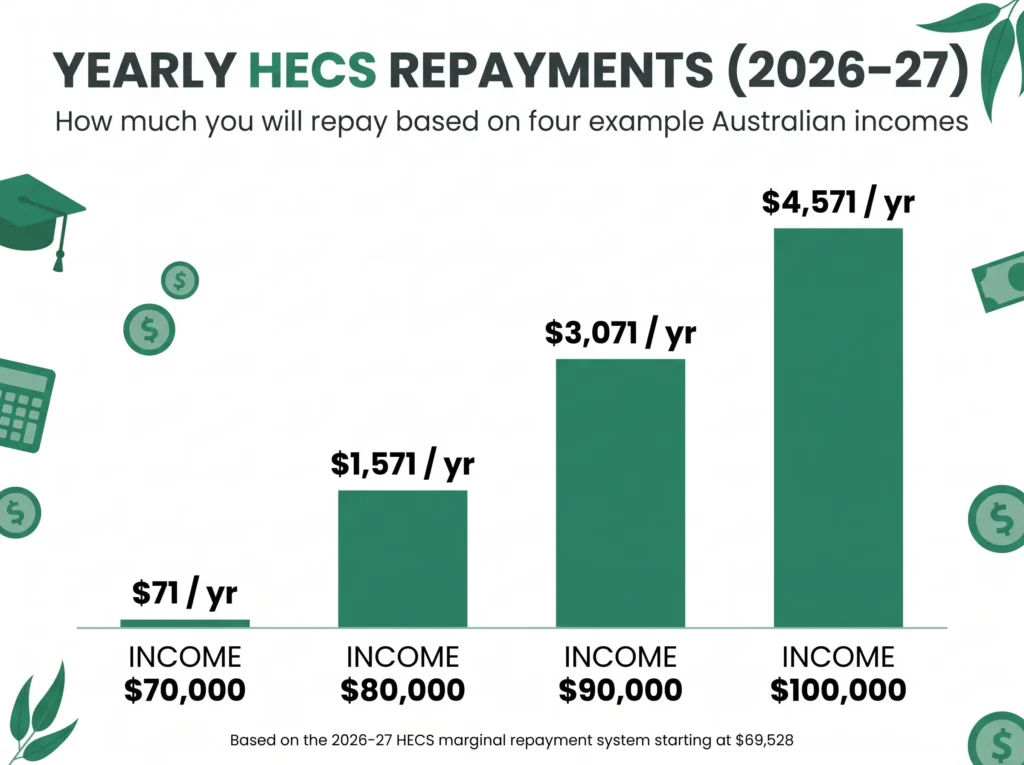
A repayment income of $100,000 means a HECS repayment of about $4,571 for the year, which is around $176 a fortnight or $88 a week. Notice how someone on $70,000 repays almost nothing, just $71 for the year, because only the $472 above the threshold is counted. Enter your exact income in the calculator for your own figure across weekly, fortnightly and monthly pay.
Worked example: HECS on a $90,000 income
Say your repayment income is $90,000 for 2026-27. The first $69,528 is below the threshold, so nothing is repaid on it. The amount above the threshold is $20,472, and at the first rate of 15 percent that comes to $3,071 for the year. Split across the year, your employer withholds about $118 a fortnight, or $59 a week, shown on your payslip as STSL.
This is where the marginal system helps. If you get a $5,000 pay rise to $95,000, only that extra $5,000 is charged at 15 percent, which adds $750 to your yearly repayment. Under the old system that ended in 2025, crossing a threshold applied the rate to your whole income, so a small rise could cost you hundreds more than the rise itself. That trap is gone. The HECS repayment calculator above shows the effect of any income straight away.
How does a salary increase affect my HECS repayment?
A pay rise lifts your HECS repayment, but only on the extra income, not on everything you earn. Because the system is marginal, each extra dollar above the threshold is charged at the rate for its band, so earning more always leaves you ahead overall.
The one thing to watch is a jump into the next band. The rate rises from 15 percent to 17 percent once your income passes $129,717, but even then the higher rate only applies to the income above that point, not below it. So a rise never leaves you worse off, it just means a slightly larger repayment on the part that moved up.
What is repayment income, and why is your HECS higher than you expected?
This is where many people get caught out. Your HECS repayment is not worked out on your salary alone. It is worked out on your repayment income, which is your taxable income plus several things added back on.
Repayment income includes your taxable income, plus any reportable super contributions such as salary sacrifice, plus your total net investment loss such as negative gearing, plus reportable fringe benefits, plus any exempt foreign employment income. The ATO adds these back so that people cannot lower their compulsory repayment by sacrificing income into super or gearing an investment.
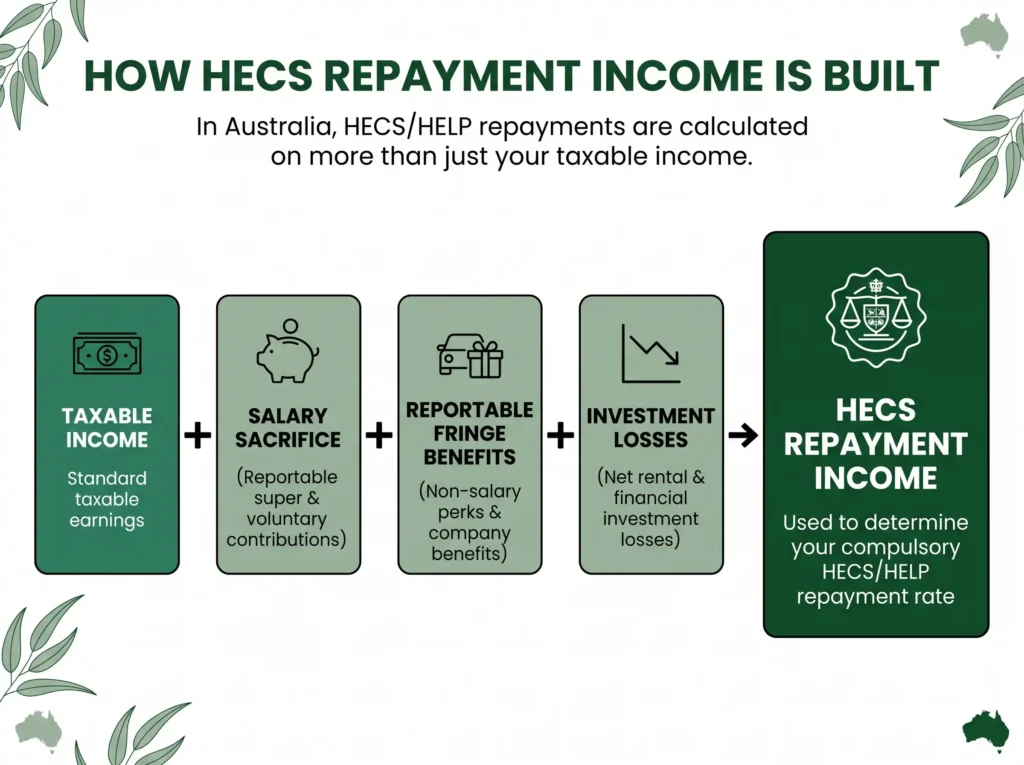
This explains two common surprises. First, salary sacrificing into super does not reduce your HECS repayment, because the sacrificed amount is added straight back into your repayment income, even though it lowers your income tax. Second, if your tax return shows a bigger HECS repayment than a simple salary-based estimate, it is almost always because these add-backs pushed your repayment income above your take-home salary. If you have an investment property running at a loss or you package part of your pay, your repayment income can be well above the figure on your employment contract.
Why did HECS take so much from my pay?
A large HECS deduction on your payslip usually comes down to how your employer withholds it. Once you earn above the threshold and have told your employer you have a study loan, they take extra from each pay to cover your expected yearly repayment, shown as STSL, which stands for study and training support loan.
Your employer works this out on your pay for that period as if you earned it all year. So a big month, a run of overtime or a bonus can push the withholding up sharply for that one pay, because the payroll system assumes that higher rate continues. It evens out when you lodge your return, since your actual repayment is based on your real income for the full year. If the withholding ran ahead of what you owed, the difference comes back in your assessment.
What changed about HECS in 2025
Two changes landed in 2025, and both worked in borrowers’ favour.
The switch from a flat rate to a marginal system
From 1 July 2025, repayments changed from a flat rate to a marginal one. Under the old system, once your income reached a threshold, the repayment rate applied to your entire income, so earning one dollar more could cost you hundreds in extra repayments. Now the rate applies only to the income above each threshold, the same way income tax brackets work. For most people this means a smaller repayment, especially for those earning just above the threshold.
The one-off 20 percent debt reduction
In 2025 the government applied a one-off 20 percent reduction to all HELP and study loan balances as they stood on 1 June 2025. The ATO applied it automatically, before indexation, so you did not need to do anything or apply for it. For someone with a $30,000 debt, that cut about $6,000 off the balance. It was a reduction to the debt itself, not to your repayments, so your compulsory repayment still depends on your income.
How HECS is withheld from your pay
If you have a study loan and earn above the threshold, your employer withholds extra tax across the year to cover your compulsory repayment, on top of your normal PAYG income tax. This is the reason your take-home pay is lower with a HECS debt than without one on the same salary, and it is why the superannuation and take-home figures you see elsewhere change once you tick the HECS option.
The amount withheld is an estimate. Your actual compulsory repayment is settled when you lodge your tax return, based on your full repayment income for the year. If too much was withheld, the difference is refunded in your assessment. If too little was withheld, you may have an amount left to pay. You can lower the gap either way by making sure your employer has the right information about your loan.
Can I stop HECS being withheld once it is paid off?
Not automatically. Your employer keeps withholding the HECS amount from your pay until you tell them to stop, because they cannot see your loan balance, only the ATO can. This is why some people keep having HECS taken out of their pay even after their debt is cleared.
When your debt is nearly paid, you can give your employer a withholding declaration asking them to stop the extra HECS withholding, so your take-home pay goes back up straight away rather than months later. If you do not, and more is withheld than you still owe, the overpayment is refunded when you lodge your return. It is worth checking your balance through myGov so you can time this right, since the money withheld does not clear your debt until you lodge.
Does the ATO refund extra HECS?
Yes, in two situations. If your employer withheld more during the year than your actual compulsory repayment, the extra comes back in your tax assessment. And if you kept having money withheld after your debt was already cleared, the ATO refunds the amount paid beyond your balance once your return is processed.
The key thing to understand is that money withheld from your pay for HECS does not reduce your debt during the year. It sits as tax withheld and is only applied to your loan when you lodge your return. So your balance does not fall with each pay, it drops once a year at assessment. This surprises people who expect to watch the debt shrink gradually through the year, and it is why your myGov balance can look unchanged for months.
How is HECS indexed each year?
Your HECS debt is indexed once a year on 1 June, which keeps it in line with the cost of living. HECS does not charge interest. Instead, indexation lifts the balance by an inflation figure, which is why the debt can grow even while you are repaying it.
Since a 2025 change, indexation is the lower of the Consumer Price Index or the Wage Price Index, rather than the Consumer Price Index alone. That reform brought the rate down compared with the old method and was backdated to ease the high indexation of earlier years. The 2026 indexation figure was 2.8 percent.
Because indexation lands on 1 June, a voluntary payment made just before that date reduces the balance that gets indexed, which can save you a little. You can check your current balance any time through myGov linked to the ATO, which is the only place that shows your live, up-to-date figure.
Is HECS tax deductible?
No. You cannot claim your compulsory HECS or HELP repayments as a tax deduction, and voluntary repayments are not deductible either. This is a common question, and the answer is the same whether the repayment was withheld from your pay or paid directly.
The one narrow exception is unrelated to your loan: if your employer pays your course fees directly as part of your job and certain conditions are met, that is a different arrangement entirely. For your own HECS debt, treat the repayments as not deductible.
Does salary packaging with a HECS debt still help?
It can still help your income tax, but it does not lower your HECS repayment. This trips people up, especially those working for not-for-profit or health employers who can package part of their pay.
Salary packaging reduces your taxable income, so it can cut the income tax you pay. But the packaged amount shows up as a reportable fringe benefit, which is added back into your repayment income for HECS. So your compulsory repayment is worked out as if you had not packaged at all. The packaging can still be worthwhile for the income tax saving, it just will not reduce the HECS side. If you are weighing this up, the salary sacrifice calculator shows the tax effect, and a registered tax agent can model your specific situation.
Should I pay off my HECS early, and how long will it take?
This depends on your situation, and it is worth thinking through rather than rushing. Voluntary repayments reduce your balance and the amount that gets indexed next 1 June, so they can save you money over time. The old 20 percent bonus for voluntary repayments ended in 2017, so there is no longer a discount for paying early.
Against that, HECS is one of the cheapest debts you will ever carry. It is indexed rather than charged interest, the repayments are income-based, and they pause automatically if your income drops below the threshold. Many people put spare money towards a mortgage, higher-interest debt or their super instead, since those often cost or earn more than HECS indexation.
How long it takes to clear depends on your income. At $90,000, repaying about $3,071 a year, a $30,000 debt takes roughly a decade, though pay rises and indexation both change that. This is general information, not advice, so weigh it against your own goals or speak with a registered tax agent or financial adviser.
HECS if you live or work overseas
If you move overseas and still have a HECS or HELP debt, your repayment obligation does not disappear. Australians living abroad must report their worldwide income to the ATO each year, and if that income is above the repayment threshold, the same compulsory repayment applies as it would at home. You report this through myGov, and the thresholds are the ones shown above. Leaving the country does not pause the debt or the indexation.
How to use this calculator
- Enter your income and choose annual, monthly, fortnightly, weekly, daily or hourly.
- The calculator applies the 2026-27 repayment threshold of $69,528 and the marginal rates.
- Read your compulsory HECS repayment for the year and for each pay cycle.
- Compare it with the STSL line on your payslip to see how your withholding tracks across the year.
Is this HECS calculator accurate?
Yes, for a full year at a steady income. It applies the ATO’s 2026-27 repayment threshold of $69,528 and the marginal rates of 15, 17 and 10 percent, and it estimates your compulsory repayment from the income you enter.
Your actual repayment can differ if your repayment income includes add-backs such as salary sacrifice, negative gearing or reportable fringe benefits, since those lift the figure the ATO uses above your salary. It is an estimate for planning, not a notice of assessment, and it does not replace advice from the ATO or a registered tax agent. See our methodology page for how each figure is worked out and when the rates were last checked.
Frequently asked questions
What is the HECS repayment threshold for 2026-27?
Compulsory repayments start once your repayment income passes $69,528. Below that, no repayment applies for the year.
Is HECS taken out of every pay?
If you earn above the threshold and told your employer you have a study loan, yes. It is withheld from each pay as STSL and applied to your debt when you lodge your return.
Does salary sacrifice reduce my HECS repayment?
No. Salary sacrifice into super is added back into your repayment income, so it does not lower your compulsory HECS repayment, even though it lowers your income tax.
Why is my HECS higher on my tax return than I expected?
Because repayment income includes add-backs such as salary sacrifice, negative gearing losses and reportable fringe benefits on top of your taxable income, which can lift it well above your salary.
How do I stop HECS coming out after I have paid it off?
Give your employer a withholding declaration to stop the extra withholding, since they cannot see your balance. Any amount withheld beyond your debt is refunded when you lodge.
How do I check my HECS balance?
Log in to myGov and link the ATO. Your live balance shows there, which is the only place it updates, since repayments withheld from your pay only apply once a year at assessment.
Does this cover HELP, FEE-HELP and VET loans?
Yes. The same thresholds and rates cover HECS-HELP, FEE-HELP, VET Student Loans, SA-HELP, OS-HELP, SFSS and the other study and training loans, so the result applies whichever you hold.
Is it worth paying off HECS early?
There is no longer a discount for voluntary repayments, and HECS is indexed rather than charged interest, so many people prioritise other debts. It can still save on future indexation. Weigh it against your own situation.
Sources and references
Every figure was checked in September 2026 against official Australian sources.
- Australian Taxation Office, study and training loan repayment thresholds and rates: ato.gov.au
- Australian Taxation Office, HELP indexation, repayment income and compulsory repayments: ato.gov.au
Reviewed by a registered tax agent
The rates and figures in this calculator were reviewed by James Wilson, CPA and registered Tax Agent with the Tax Practitioners Board, and Director of Australian Tax Advisors on the Gold Coast. The review covered the 2026-27 repayment thresholds, the marginal rates and the treatment of repayment income against current ATO rules. You can see James on LinkedIn.
Last reviewed by James Wilson, CPA, in September 2026.
Estimate only. This calculator provides general information and is not personal financial or tax advice. For advice about your own situation, speak with the ATO or a registered tax agent.