Updated for the 2026-27 financial year. Every rate on this page was checked against the Australian Taxation Office in September 2026, and reviewed by James Wilson, CPA and registered Tax Agent.
Knowing the tax brackets Australia uses for 2026-27 helps you work out how much tax you pay, what your marginal rate is, and how much of your income is actually taxed at each rate.
Australian tax brackets for 2026-27
For the 2026-27 financial year, Australian residents pay no tax on the first $18,200, then 15 percent up to $45,000, 30 percent up to $135,000, 37 percent up to $190,000, and 45 percent on income above $190,000. These rates do not include the 2 percent Medicare levy.
Here is the full resident scale, which runs from 1 July 2026 to 30 June 2027.
Taxable income | Tax rate | Tax on this income |
|---|---|---|
$0 to $18,200 | 0% | Nil |
$18,201 to $45,000 | 15% | 15c for each $1 over $18,200 |
$45,001 to $135,000 | 30% | $4,020 plus 30c for each $1 over $45,000 |
$135,001 to $190,000 | 37% | $31,020 plus 37c for each $1 over $135,000 |
$190,001 and over | 45% | $51,370 plus 45c for each $1 over $190,000 |
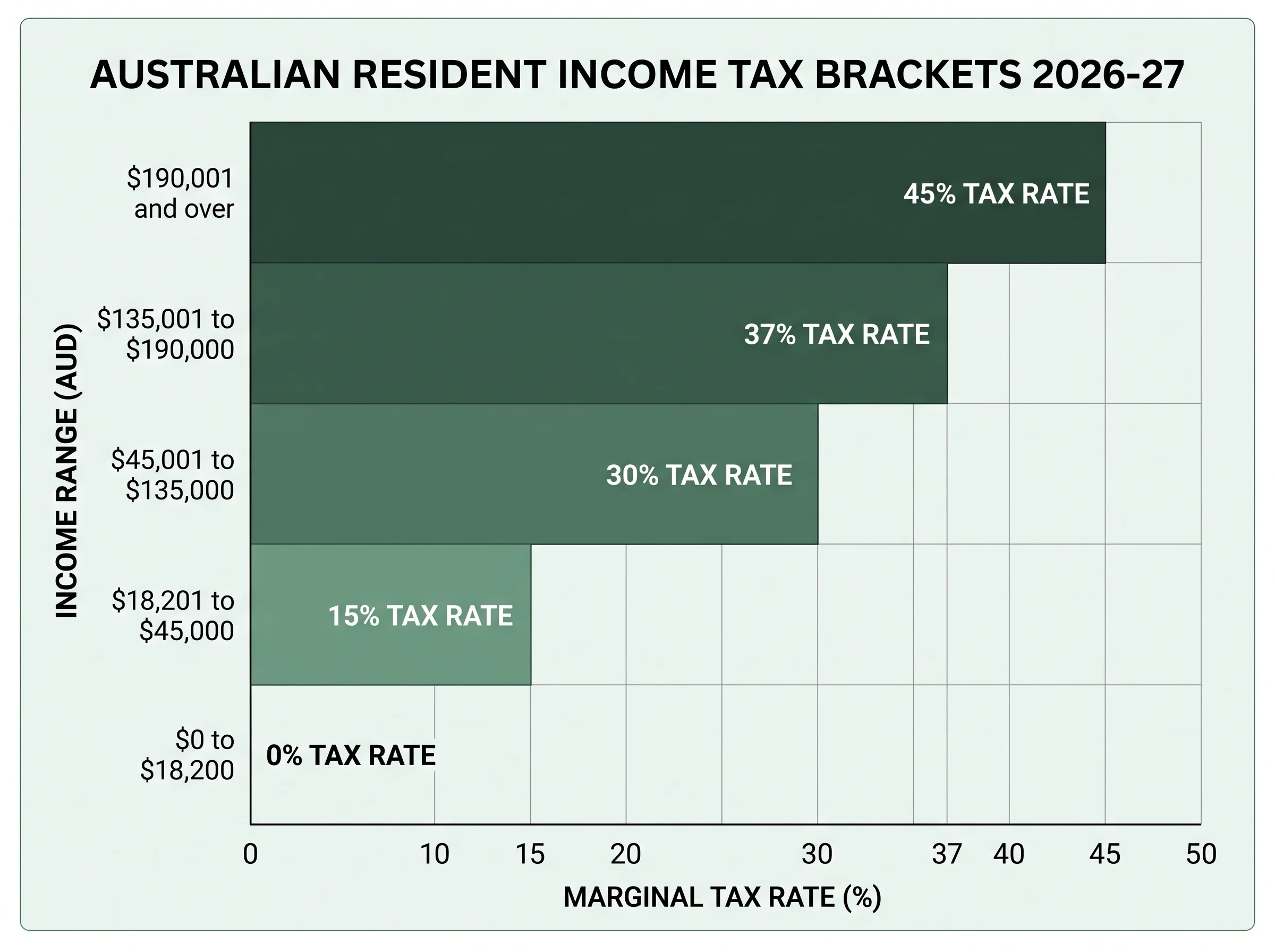
The tax brackets Australia uses are progressive, which means your income is taxed in slices, not all at one rate.
Do you pay tax on your whole income?
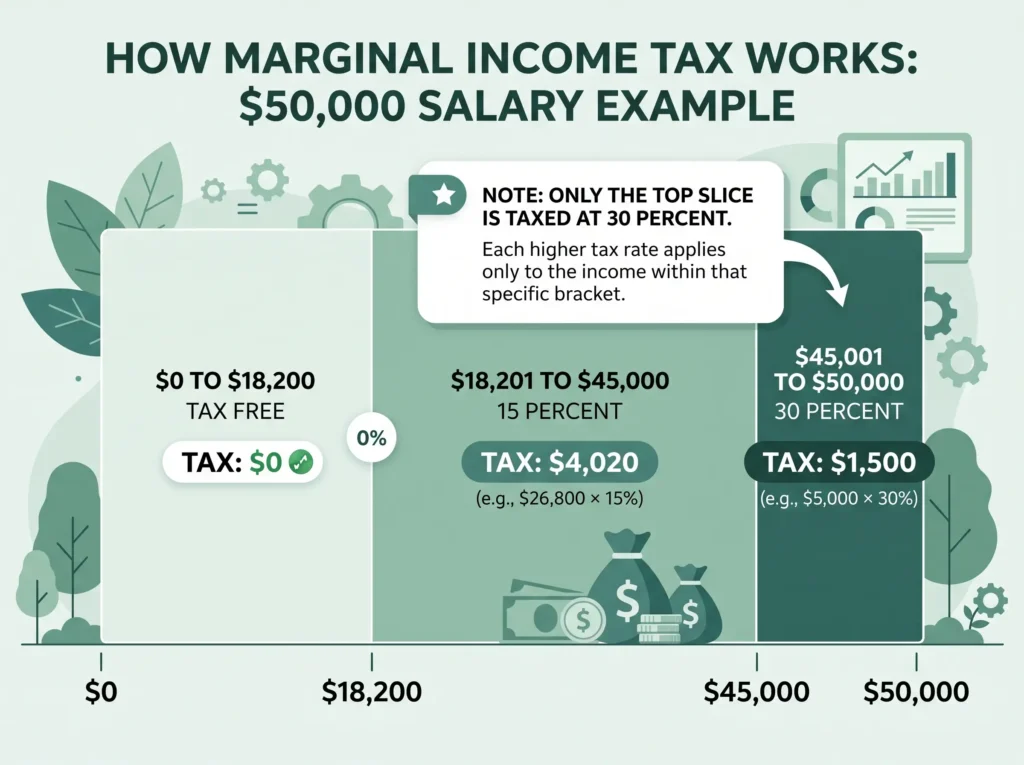
No. This is the most common thing people get wrong about tax brackets. Each rate applies only to the part of your income that falls inside that bracket, not to your whole income. Moving into a higher bracket does not tax everything you earn at the higher rate.
Say you earn $50,000. That puts you in the 30 percent bracket, but you do not pay 30 percent on $50,000. Your first $18,200 is tax free, the next $26,800 is taxed at 15 percent, and only the last $5,000 is taxed at 30 percent. Your total income tax is about $5,520, an effective rate of roughly 11 percent, not 30. Earning more never leaves you worse off overall, because only the extra dollars are taxed at the higher rate.
How the brackets are applied
Here is how the tax on an $80,000 salary is built for a resident in 2026-27, one slice at a time.
The first $18,200 is tax free. The next slice, from $18,201 to $45,000, is $26,800 taxed at 15 percent, which is $4,020. The slice from $45,001 to $80,000 is $35,000 taxed at 30 percent, which is $10,500. Add them together and the income tax is $14,520. The Medicare levy then adds 2 percent of $80,000, which is $1,600, for a total of $16,120.
How much tax do I pay in Australia?
The tax brackets Australia applies decide how much tax you pay: your taxable income and the brackets above set the amount, plus the 2 percent Medicare levy that most residents pay. As a guide, a resident on $60,000 pays about $9,620 in total, on $100,000 about $22,520, and on $150,000 about $39,570, including the levy.
For a figure based on your own income, including HECS, super and residency, use our income tax calculator.
How income tax is calculated
The ATO works out your tax in a set order. It starts with your assessable income, such as salary, wages and investment income. It takes off your allowable deductions to give your taxable income. It applies the tax rates above to get your gross tax. It then subtracts any tax offsets, adds the Medicare levy, and subtracts the tax already withheld from your pay. What is left is either a refund or a bill.
In short: assessable income minus deductions equals taxable income. Apply the rates, take off offsets, add the Medicare levy, and compare with the tax already paid.
The tax-free threshold explained
The tax-free threshold is $18,200. If you are an Australian resident, the first $18,200 you earn in a financial year is not taxed. You claim it from one job only, usually your main one.
Because of the Low Income Tax Offset, most residents actually pay no income tax until they earn around $22,867. The threshold has not changed since the 2012-13 year, which is one reason many Australians feel their tax has crept up over time even when the rates have not.
Your marginal rate versus your effective rate
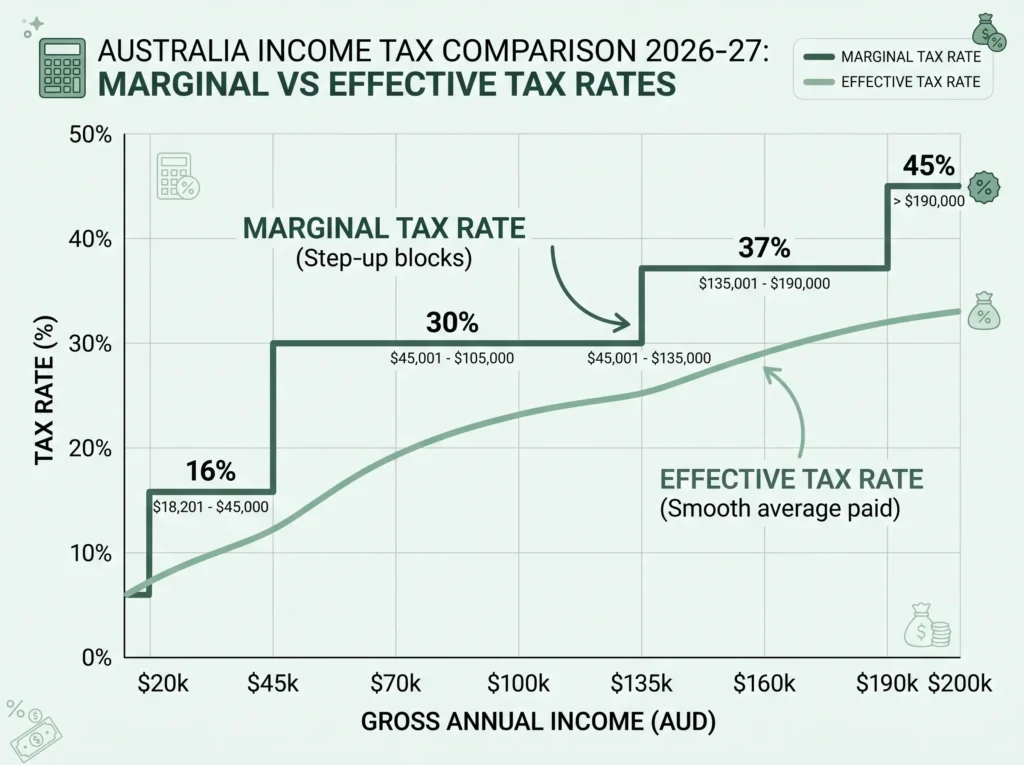
Your marginal rate is the rate on your next dollar. Your effective rate is your total tax as a share of your whole income. The two are often confused, and the difference matters.
On $100,000, your marginal rate is 30 percent, so a pay rise is taxed at 30 percent. But your effective rate is only about 22.5 percent, because the lower brackets tax part of your income at 0, 15 and 30 percent. The effective rate is always lower than the marginal rate, which is why a “47 percent tax bracket” almost never means someone pays 47 percent of their income.
What changed on 1 July 2026
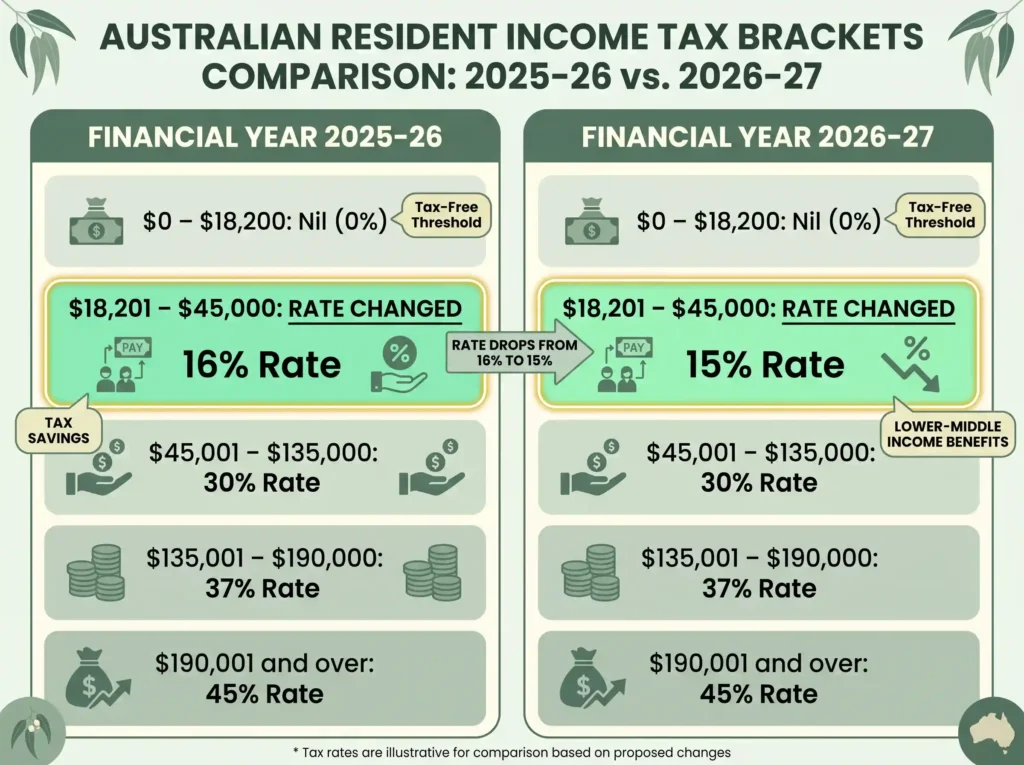
The rate on income between $18,201 and $45,000 dropped from 16 percent to 15 percent on 1 July 2026. For anyone earning $45,000 or more, that is a saving of up to $268 a year. The thresholds themselves did not move, and the other rates stayed the same.
Here is how the two years compare.
Taxable income | Rate 2025-26 | Rate 2026-27 |
|---|---|---|
$0 to $18,200 | 0% | 0% |
$18,201 to $45,000 | 16% | 15% |
$45,001 to $135,000 | 30% | 30% |
$135,001 to $190,000 | 37% | 37% |
$190,001 and over | 45% | 45% |
What is coming from 1 July 2027
Two further changes are already law but do not apply yet. From 1 July 2027, the 15 percent rate falls again to 14 percent, which roughly doubles the yearly saving. And a new Working Australians Tax Offset (WATO) of up to $250 begins from the 2027-28 income year, reducing the tax on income from work. Neither of these affects your 2026-27 tax, so ignore them when working out this year’s figures.
The top tax bracket in Australia
The top tax bracket is 45 percent, and it applies to taxable income above $190,000. With the 2 percent Medicare levy on top, the highest earners pay 47 cents in tax on each dollar above that line. This threshold has moved very little over the years, rising from $180,000 to $190,000, which is a common point of debate about the tax system.
Tax brackets for foreign residents
Foreign residents are taxed differently. They do not get the $18,200 tax-free threshold, and they pay 30 percent from the first dollar. They also generally do not pay the Medicare levy.
Taxable income | Tax rate |
|---|---|
$0 to $135,000 | 30% |
$135,001 to $190,000 | $40,500 plus 37c for each $1 over $135,000 |
$190,001 and over | $60,850 plus 45c for each $1 over $190,000 |
Tax brackets for working holiday makers
If you are here on a 417 or 462 visa, a special scale applies. Your first $45,000 is taxed at a flat 15 percent, then the standard resident thresholds apply above that. There is no tax-free threshold and no Medicare levy.
Taxable income | Tax rate |
|---|---|
$0 to $45,000 | 15% |
$45,001 to $135,000 | $6,750 plus 30c for each $1 over $45,000 |
$135,001 to $190,000 | $33,750 plus 37c for each $1 over $135,000 |
$190,001 and over | $54,100 plus 45c for each $1 over $190,000 |
What counts as taxable income
Your tax is charged on your taxable income, not your gross pay. Taxable income is your assessable income, such as salary, wages, interest, dividends and rent, minus your allowable deductions, such as work-related expenses, donations and the cost of managing your tax. For most employees on a single wage, taxable income is close to gross pay. Salary sacrifice into super and work deductions both lower it.
How tax offsets reduce your tax
An offset reduces the tax you owe, dollar for dollar. It is different from a deduction, which reduces your taxable income first.
Low Income Tax Offset (LITO)
LITO is worth up to $700 for people earning up to $37,500, and it phases out by the time income reaches $66,667. It is applied automatically when you lodge. It is the reason most residents pay no income tax until around $22,867.
Seniors and Pensioners Tax Offset (SAPTO)
SAPTO is for eligible older Australians and pensioners. It can be worth over $2,000 for singles and can remove a tax bill entirely for some recipients, and in some cases it removes the need to lodge a return at all.
The Medicare levy and surcharge on top of your bracket
The tax brackets do not include the Medicare levy, so this sits on top of the rates above.
Medicare levy
Most residents pay a Medicare levy of 2 percent of taxable income, which helps fund public healthcare. Lower earners pay a reduced levy or none. For a single person, no levy applies below about $28,011, with a partial levy up to around $35,000.
Medicare Levy Surcharge
Higher earners who do not hold private hospital cover may also pay the Medicare Levy Surcharge. For a single person in 2026-27 it starts above $105,000 and is charged at 1 percent, 1.25 percent or 1.5 percent depending on income. Taking out basic hospital cover can remove it.
The new $1,000 instant deduction
From the 2026-27 year, eligible workers can claim a standard $1,000 deduction for work-related expenses without keeping receipts. If your real work expenses are higher, you claim the actual amount instead, with records. It reduces your taxable income rather than your tax bill directly, so it is worth up to $300 at the 30 percent rate, $370 at 37 percent and $450 at 45 percent. It first applies in returns lodged from July 2027.
How much tax on common incomes
This table shows the total tax, marginal rate and effective rate for a single Australian resident in 2026-27, including the Medicare levy and no study loan. These figures come from the same rates our calculator uses.
Taxable income | Income tax | Medicare levy | Total tax | Marginal rate | Effective rate |
|---|---|---|---|---|---|
$60,000 | $8,420 | $1,200 | $9,620 | 30% | 16.0% |
$80,000 | $14,520 | $1,600 | $16,120 | 30% | 20.2% |
$100,000 | $20,520 | $2,000 | $22,520 | 30% | 22.5% |
$150,000 | $36,570 | $3,000 | $39,570 | 37% | 26.4% |
$200,000 | $55,870 | $4,000 | $59,870 | 45% | 29.9% |
Notice how the effective rate stays well below the marginal rate at every income. Even at $200,000, where the marginal rate is 45 percent, the effective rate is under 30 percent.
Bracket creep, in plain terms
Bracket creep is what happens when your pay rises with inflation but the tax thresholds do not. As your income grows, more of it is pushed into higher brackets, so you pay a larger share in tax even though you are not really better off. Australia’s thresholds are not automatically indexed to inflation, so this happens quietly year after year until a government adjusts the brackets. It is the main reason the tax-free threshold sitting at $18,200 since 2012-13 draws so much comment.
Frequently asked questions
How many tax brackets are there in Australia?
There are five for residents: a tax-free bracket, then the 15, 30, 37 and 45 percent brackets.
What tax bracket am I in?
Your bracket is set by your taxable income, which is your income after deductions. Find the row in the table above that your taxable income falls into.
Is the Medicare levy part of my tax bracket?
No. The levy is a separate 2 percent charge worked out on your taxable income and added on top of the bracket rates.
Have the tax brackets changed for 2026-27?
The rate on income between $18,201 and $45,000 fell from 16 percent to 15 percent on 1 July 2026. The thresholds and other rates are unchanged.
What are the Stage 3 tax cuts?
They are a set of tax cuts phased in from 2024, which reshaped the brackets and lowered rates for most workers. The 1 July 2026 cut to 15 percent builds on them.
Do foreign residents get the tax-free threshold?
No. Foreign residents pay 30 percent from the first dollar and do not receive the $18,200 threshold.
Work out your own tax
The tax brackets Australia applies for 2026-27 are shown in the tables above. To see the tax on your exact income, with the Medicare levy, HECS and your residency applied, use our income tax calculator or the full pay calculator for your take-home pay.
Sources and references
Every figure was checked in September 2026 against official Australian sources.
- Australian Taxation Office, individual income tax rates for residents, foreign residents and working holiday makers: ato.gov.au
- Australian Taxation Office, Medicare levy, LITO and the Working Australians Tax Offset: ato.gov.au
Reviewed by a registered tax agent
The rates and figures on this page were reviewed by James Wilson, CPA and registered Tax Agent with the Tax Practitioners Board, and Director of Australian Tax Advisors on the Gold Coast. The review covered the 2026-27 brackets, the Medicare levy, offsets and the working holiday and foreign resident scales against current ATO rates. You can see James on LinkedIn.
Last reviewed by James Wilson, CPA, in September 2026.
Information only. This page provides general information and is not personal financial or tax advice. For advice about your own situation, speak with the ATO or a registered tax agent.