
PAYG Calculator Australia
See how much PAYG your employer withholds from each pay.
PAYG withheld a year
from $0 gross, leaving $0 take-home
PAYG withheld by pay cycle
| Period | Gross | PAYG withheld | Take-home |
|---|
What makes up your PAYG withholding
PAYG is what your employer holds back each pay. It does not include the Medicare Levy Surcharge or super, which are handled separately. Rates verified against the ATO for 2026-27.
PAYG calculator Australia shows how much tax your employer withholds from each pay in Australia, using ATO rates for the 2026-27 financial year. Enter your income and residency, and it shows your PAYG withholding weekly, fortnightly, monthly and yearly, plus what you take home. It was reviewed by James Wilson, CPA and registered Tax Agent.
What is PAYG withholding?
PAYG withholding is the tax your employer takes out of each pay and sends to the Australian Taxation Office on your behalf. PAYG stands for pay as you go, which means you pay your income tax gradually across the year instead of in one lump sum at tax time.
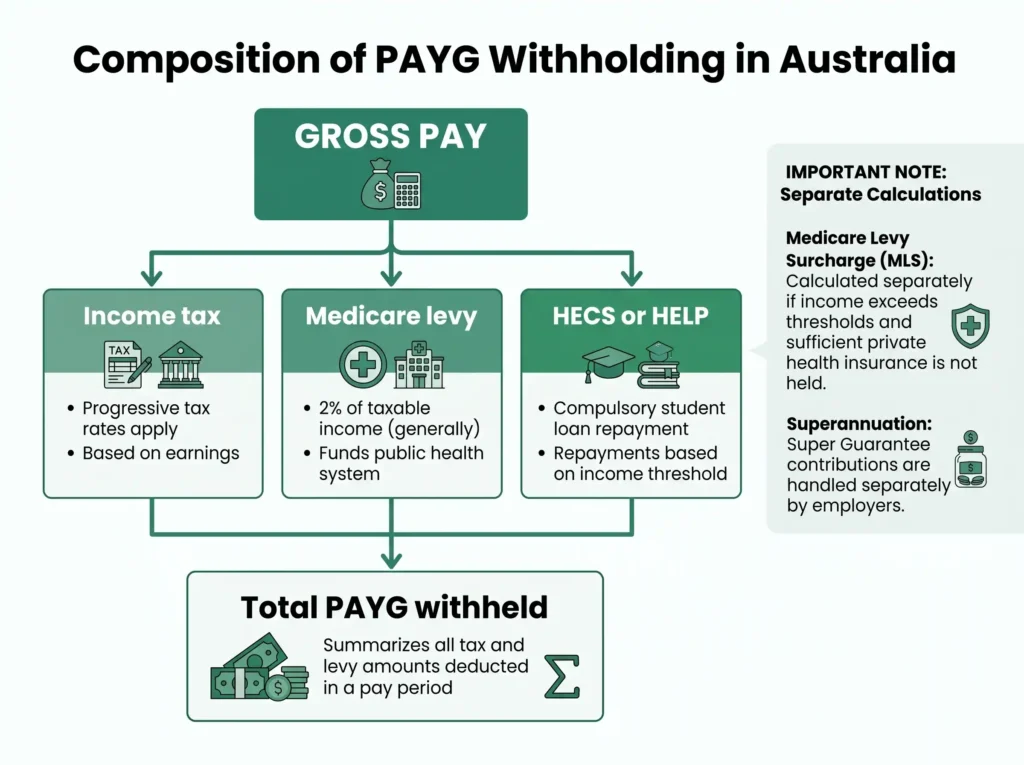
It is made up of your income tax plus the Medicare levy, and a study loan repayment if you have one. Your employer works out the amount using the ATO tax tables, holds it back, and pays you the rest as your take-home pay.
How much PAYG is withheld from my pay?
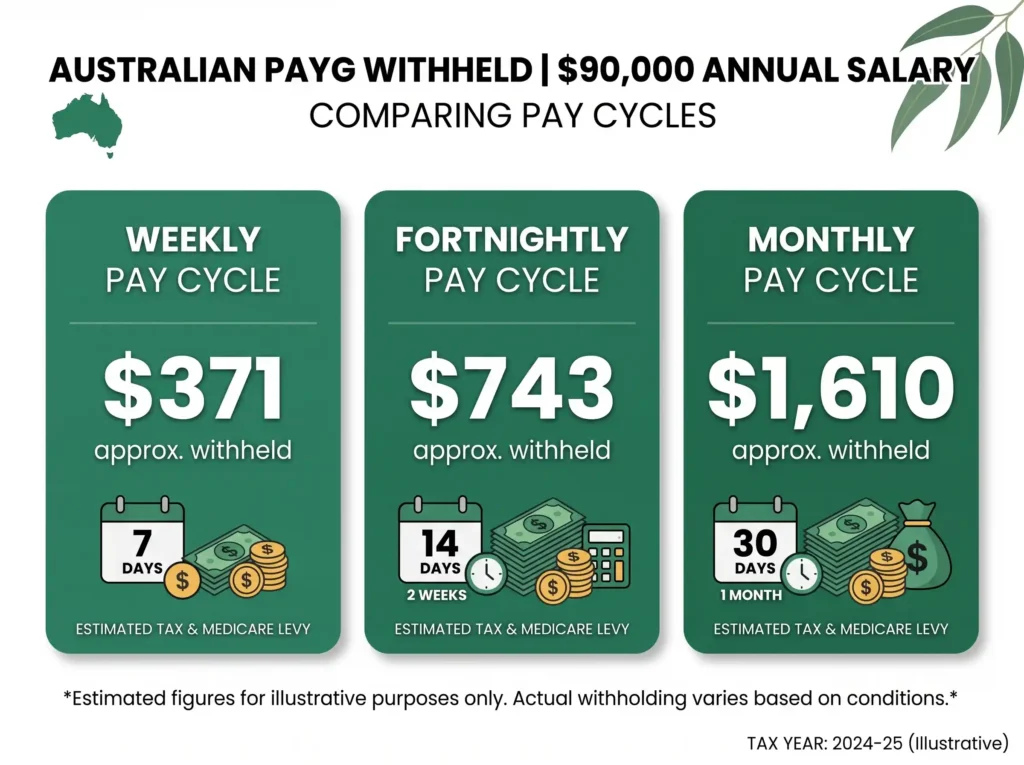
The amount depends on your income, how often you are paid, and your residency. As a guide, an Australian resident on $90,000 has about $19,320 withheld a year, which is roughly $743 a fortnight or $371 a week. On $60,000 it is about $9,620 a year, close to $370 a fortnight.
Enter your own figure in the calculator above and it shows the PAYG withheld for every pay cycle, so you can check it against your payslip.
What makes up your PAYG
Your PAYG withholding is not one single tax. It is a few things added together and held back each pay.
Income tax
The largest part. Income tax is charged on your taxable income using the marginal tax brackets, and your employer withholds it gradually from each pay rather than all at once.
The Medicare levy
Most Australian residents pay a Medicare levy of 2 percent of taxable income, and it is withheld along with your income tax. Foreign residents and working holiday makers do not pay it.
HECS and HELP repayments
If you have a study or training loan, your employer withholds an extra amount once your income passes the repayment threshold, which is $69,528 for 2026-27. Tick the HECS box in the calculator to include it.
What PAYG does not include
Two things people often expect to see in PAYG but are handled separately. The Medicare Levy Surcharge is not withheld through PAYG, it is worked out when you lodge your return. And superannuation is not part of PAYG at all, your employer pays super on top of your wage, not out of it. The calculator keeps both of these out of the withheld figure, which is how the ATO treats them.
How is PAYG calculated in Australia?
PAYG is calculated from the ATO tax tables. The ATO publishes weekly, fortnightly and monthly tax tables that tell your employer how much to withhold from each pay based on your earnings and the details on your tax file number declaration.
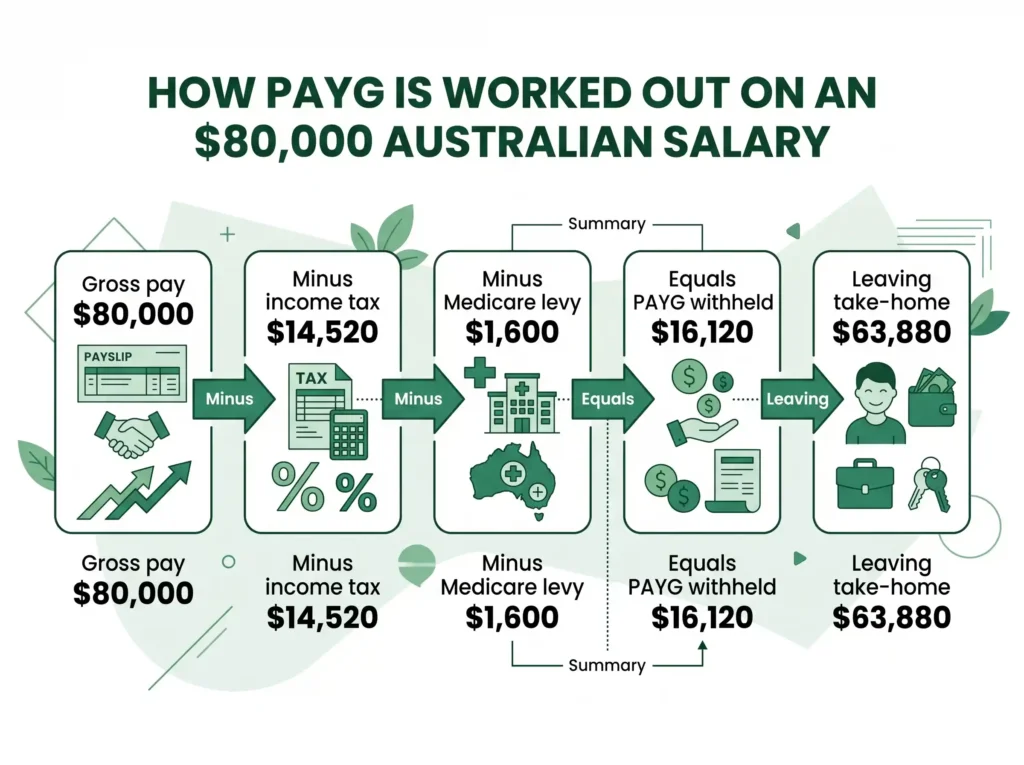
This calculator uses the same ATO rates and formulas, so it gives you the plain version of the ATO’s own tax withheld calculator, with your result broken down by pay cycle. The steps are simple: start with your gross pay for the period, apply the tax rates, add the Medicare levy, add any study loan repayment, and the total is your PAYG. What is left is your take-home pay.
Here is a worked example on an $80,000 salary for a resident. The first $18,200 is tax free. The next $26,800 is taxed at 15 percent, which is $4,020. The slice from $45,001 to $80,000 is taxed at 30 percent, which is $10,500. That gives $14,520 in income tax. The Medicare levy adds 2 percent of $80,000, which is $1,600. So the PAYG withheld is $16,120 a year, about $620 a fortnight, and the take-home is $63,880.
PAYG withholding versus PAYG instalments
These sound the same but they are two different things, and mixing them up is common.
PAYG withholding is what an employer takes out of an employee’s pay. If you are an employee, this is the one that applies to you, and it is what this calculator works out.
PAYG instalments are prepayments that businesses, sole traders and investors make towards the tax on their own income, usually quarterly. If you run a business or earn investment income, that is a separate system with its own rules. This page is about withholding, not instalments.
Income tax rates and the tax-free threshold for 2026-27
PAYG is built from the resident tax rates, so it helps to see them. For 2026-27, residents pay nothing on the first $18,200, then 15 percent up to $45,000, 30 percent up to $135,000, 37 percent up to $190,000, and 45 percent above that.
Taxable income | Tax rate |
|---|---|
$0 to $18,200 | 0% |
$18,201 to $45,000 | 15% |
$45,001 to $135,000 | 30% |
$135,001 to $190,000 | 37% |
$190,001 and over | 45% |
The 15 percent rate is new for this year, down from 16 percent on 1 July 2026, so your PAYG is slightly lower than last year if you earn over $45,000. These rates do not include the 2 percent Medicare levy, which is withheld on top.
Why your PAYG might differ from your final tax
PAYG is an estimate, not your final tax bill. Your employer withholds using the ATO tables, which are built to be close across a full year at a steady income. Your actual tax is worked out when you lodge your return.
So if more was withheld than you owe, you get a refund. If less was withheld, you get a bill. Small differences are normal, and they are the whole reason tax returns exist.
Why is my PAYG so high, or 47 percent of my pay?
If a big chunk of a pay is withheld, it is usually one of two things. If you did not give your employer a tax file number, they must withhold at 47 percent, which is the top rate plus the Medicare levy. Giving them your TFN fixes this. The other common cause is a second job where you have not claimed the tax-free threshold, so that job is taxed from the first dollar and feels heavily taxed compared with your main one.
Neither is a mistake by the ATO. In both cases the extra withholding is sorted out when you lodge, and any overpayment comes back as a refund.
The situations that change your PAYG
A few specific situations change how much is withheld, and the ATO tables handle each one.
A second job with no tax-free threshold
You can only claim the $18,200 tax-free threshold from one employer. Your second job is taxed from the first dollar, so more PAYG comes out of it. This is correct, and it stops you getting a large tax bill at the end of the year.
When there are 27 fortnights or 53 weeks
Most years have 26 fortnights or 52 weeks, but some have an extra pay period. In those years the standard tables can withhold slightly less than your full-year tax, so some people ask their employer to withhold a little extra to avoid a small bill.
No tax file number provided
If you have not given your employer your TFN within 28 days, they must withhold at the top rate of 47 percent. Lodging your TFN declaration fixes it going forward.
Salary sacrifice
Salary sacrificing into super lowers your taxable income, so less PAYG is withheld from your pay. The calculator’s includes-super option handles a total package figure for you.
PAYG by pay cycle: weekly, fortnightly and monthly
Because PAYG is worked out from the ATO’s weekly, fortnightly and monthly tables, the amount withheld depends on how often you are paid, though the yearly total is the same. Fortnightly is the most common cycle in Australia. The calculator shows all cycles at once so you can match the one on your payslip.
PAYG for foreign residents and working holiday makers
Residency changes the withholding scale. Foreign residents get no tax-free threshold and have 30 percent withheld from the first dollar, and they do not pay the Medicare levy. Working holiday makers on a 417 or 462 visa have 15 percent withheld on the first $45,000, then the standard rates above that. Switch the residency setting in the calculator to see the right figures.
How much PAYG on common salaries in 2026-27
This table shows the PAYG withheld for a single Australian resident with no study loan, using the verified 2026-27 rates. PAYG here is income tax plus the Medicare levy. Super is paid on top and is not included.
Annual salary | PAYG a year | PAYG a fortnight | Take-home a year |
|---|---|---|---|
$60,000 | $9,620 | $370 | $50,380 |
$80,000 | $16,120 | $620 | $63,880 |
$100,000 | $22,520 | $866 | $77,480 |
$120,000 | $28,920 | $1,112 | $91,080 |
The PAYG on a $100,000 salary is about $22,520 a year, or $866 a fortnight, leaving $77,480 take-home. Enter your exact figure for a precise result.
How to use this calculator
1. Enter your income and choose annual, monthly, fortnightly, weekly, daily or hourly.
2. Set your residency: Australian resident, foreign resident or working holiday maker.
3. Tick HECS or HELP, or includes super, if they apply.
4. Read your PAYG withheld for each pay cycle, with the full breakdown.
Is this PAYG calculator Australia accurate?
Yes, for a full year at a steady income. This PAYG calculator Australia applies the ATO 2026-27 rates and formulas that sit behind the tax tables: the resident, foreign resident and working holiday scales, the tax-free threshold, the Low Income Tax Offset, the 2 percent Medicare levy and the HELP thresholds.
It gives an estimate, not a payslip or a notice of assessment. Real withholding can differ slightly because of payroll rounding, your employer’s settings, a mid-year pay change, or an extra pay period in the year. See our methodology page for how each figure is worked out and when the rates were last checked.
Frequently asked questions
What does PAYG mean on my payslip?
It is the pay as you go tax your employer has withheld from that pay and sent to the ATO. It covers your income tax and the Medicare levy, plus any study loan repayment.
Is PAYG the same as income tax?
Not quite. PAYG withholding is the method of collecting your income tax gradually from each pay, and it also includes the Medicare levy and any HELP repayment. Income tax is the main part of it.
What is PAYG tax and how do I get it back?
If your employer withheld more PAYG than your final tax, the excess comes back as a refund when you lodge your tax return after 30 June. You do not claim it separately, it is worked out on your return.
How much PAYG is withheld for two jobs?
You claim the tax-free threshold from one job only, so your second job has PAYG withheld from the first dollar. That is correct and prevents a tax bill at the end of the year.
Is my employer withholding too much PAYG?
It can look high on a second job or if your TFN is not lodged. Enter your income here to see the expected amount. If your payslip is far off, check your TFN declaration with your employer, and any overpayment is refunded at tax time.
What is the PAYG threshold?
PAYG withholding starts once your income passes the tax-free threshold of $18,200 for residents, since that is the point where income tax begins. A study loan adds withholding once your income passes $69,528 for 2026-27.
Is this the same as the ATO tax withheld calculator?
It uses the same ATO rates and tax tables, so the result lines up. This version shows your PAYG broken down by every pay cycle and explains what makes up the figure, which the ATO tool does not.
Does my PAYG include super?
No. Super is paid by your employer on top of your wage and is not part of PAYG withholding.
Sources and references
Every figure was checked in September 2026 against official Australian sources.
- Australian Taxation Office, Tax withheld calculator and PAYG withholding: ato.gov.au
- Australian Taxation Office, individual income tax rates and the Medicare levy: ato.gov.au
Reviewed by a registered tax agent
The rates and figures in this calculator were reviewed by James Wilson, CPA and registered Tax Agent with the Tax Practitioners Board, and Director of Australian Tax Advisors on the Gold Coast. The review covered the 2026-27 income tax, Medicare levy and HELP withholding against current ATO rates. You can see James on LinkedIn.
Last reviewed by James Wilson, CPA, in September 2026.
Estimate only. This calculator provides general information and is not personal financial or tax advice. For advice about your own situation, speak with the ATO or a registered tax agent.