
Superannuation Calculator Australia
See how much super your employer should pay on your salary.
Employer super a year (12%)
that is $0 a fortnight into your fund, on top of your $0 salary
Your super by pay cycle
| Period | Salary | Super (12%) | Total |
|---|
Full breakdown
Super is paid on top of your salary at the 12% Superannuation Guarantee rate for 2026-27. The concessional contributions cap is $32,500. Verified against the ATO.
This superannuation calculator shows how much super your employer should pay on your salary, using the 12 percent rate for the 2026-27 financial year. Enter your pay and it shows your super weekly, fortnightly, monthly and yearly, plus your total package. It was reviewed by James Wilson, CPA and registered Tax Agent.
How much super should my employer pay me?
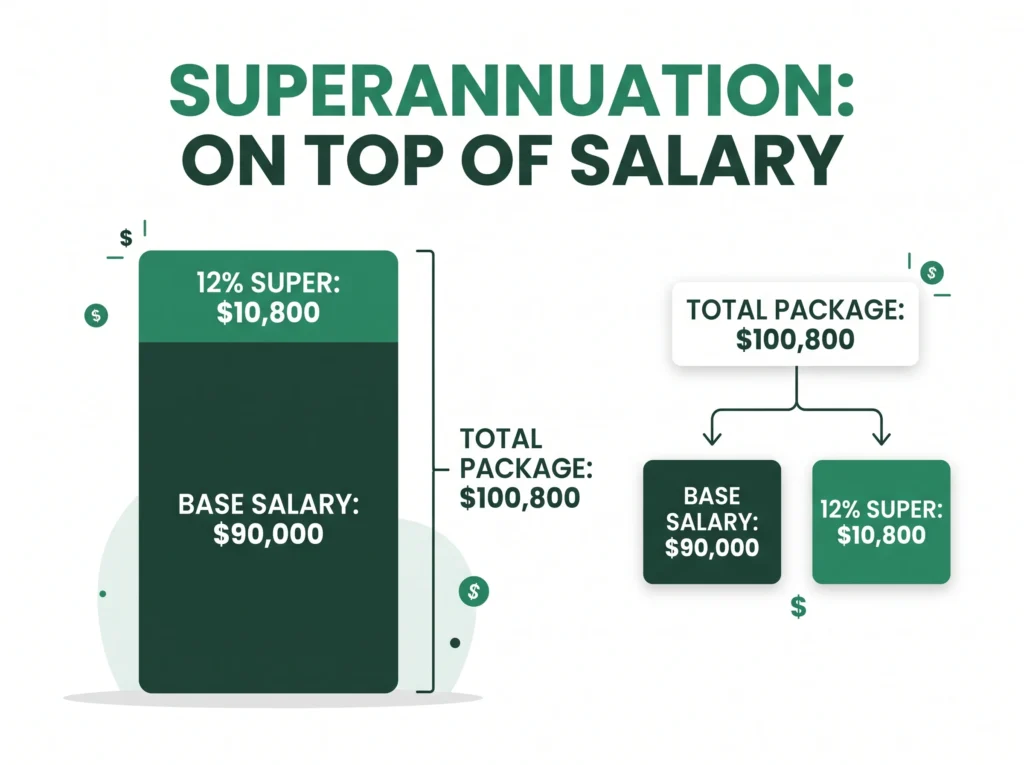
Your employer must pay super worth 12 percent of your ordinary earnings. On a $90,000 salary that is $10,800 a year, which works out to about $415 a fortnight, paid into your super fund on top of your wage. On $60,000 it is $7,200 a year, and on $120,000 it is $14,400.
This is called the super guarantee, and it is the minimum your employer has to pay. Enter your own salary in the calculator above to see your super for every pay cycle.
How do you calculate superannuation from your salary?
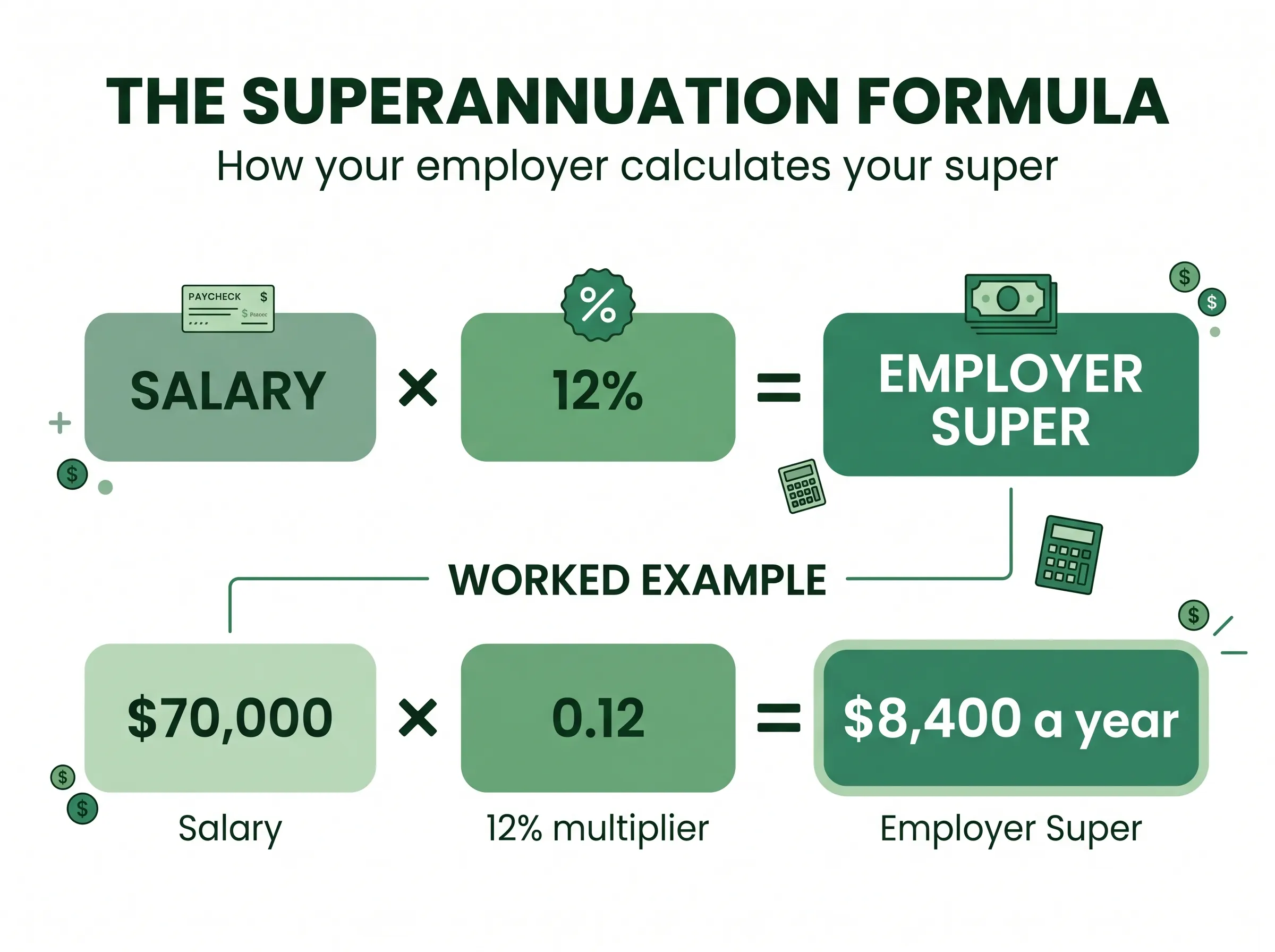
Super is worked out as 12 percent of your ordinary time earnings. To calculate it, multiply your salary by 0.12. So on $70,000 the super is $70,000 times 0.12, which is $8,400 a year.
Ordinary time earnings, or OTE, is most of what you earn for your normal hours. It includes your salary or wages, most allowances, bonuses and paid leave. It usually does not include overtime, because overtime is not part of your ordinary hours. The calculator uses your salary as the OTE figure, which is right for most employees on a steady wage.
Is super on top of my salary or included?
Usually it is on top. For most jobs, the super guarantee is paid on top of your salary, so a $90,000 salary means $90,000 in your pocket before tax, plus $10,800 of super going into your fund. The two are separate.
The exception is a job advertised as a total remuneration package, where super is bundled into the headline figure. If a role is quoted as “$100,800 package including super,” your base salary is actually $90,000 and the super is $10,800 of that total. Tick the “my salary includes super” box in the calculator and it pulls the super back out, so you can see your real base pay. Always check which way an offer is quoted before you compare it with another.
What is the super guarantee rate for 2026-27?
The super guarantee rate is 12 percent for the 2026-27 financial year. It also sat at 12 percent for 2025-26. The rate rose in steps over several years and reached its legislated top of 12 percent on 1 July 2025, so it is steady now rather than climbing each July as it did before.
That means for every $100,000 you earn in ordinary pay, your employer puts $12,000 into your super. There are no further rate rises legislated for now, so you can plan on 12 percent staying put for the 2026-27 and 2027-28 years unless the government changes the law.
When is super calculated and paid? Payday Super
From 1 July 2026, your employer must pay your super at the same time as your wages under a change called Payday Super. Before this, employers only had to pay super quarterly, which meant some people waited months to see contributions land, and unpaid super was harder to spot.
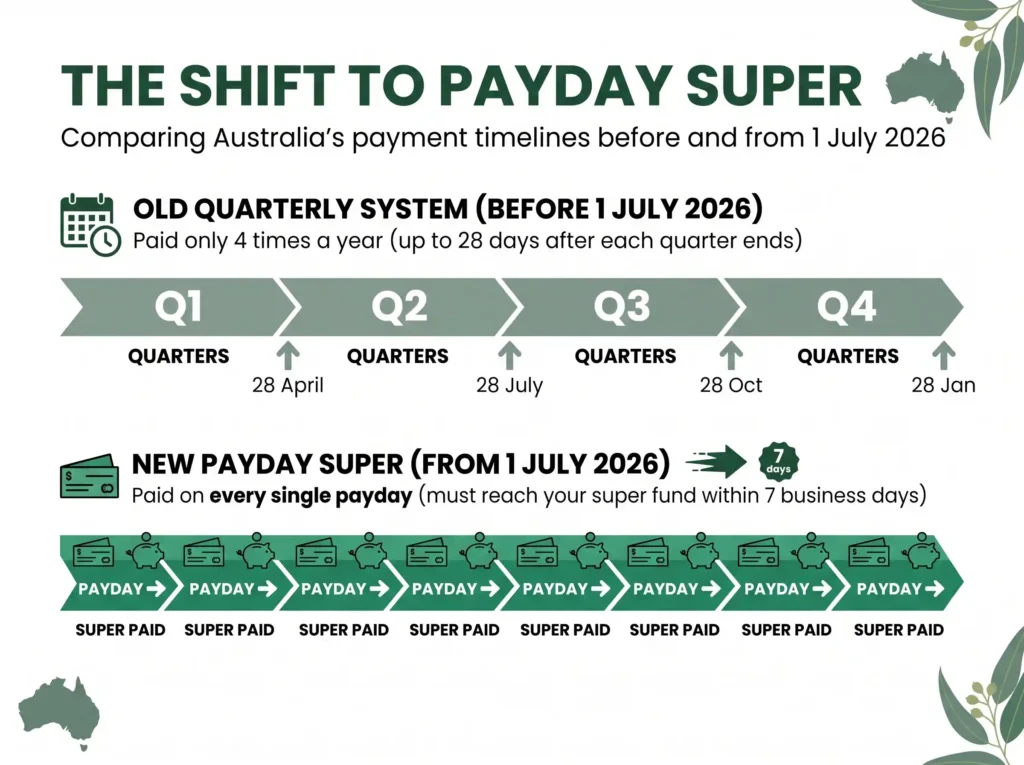
Now the super on each pay should reach your fund within a few days of that pay. This makes it much easier to check that you are actually being paid the super you are owed, since it should appear close to every payday rather than once every three months.
How much super on common salaries in 2026-27
This table shows the employer super for a range of salaries at the 12 percent rate, with the amount per fortnight and your total package. Super is paid on top of your salary, so it adds to your total value, not your take-home pay.
Annual salary | Super a year | Super a fortnight | Total package |
|---|---|---|---|
$60,000 | $7,200 | $276.92 | $67,200 |
$80,000 | $9,600 | $369.23 | $89,600 |
$100,000 | $12,000 | $461.54 | $112,000 |
$120,000 | $14,400 | $553.85 | $134,400 |
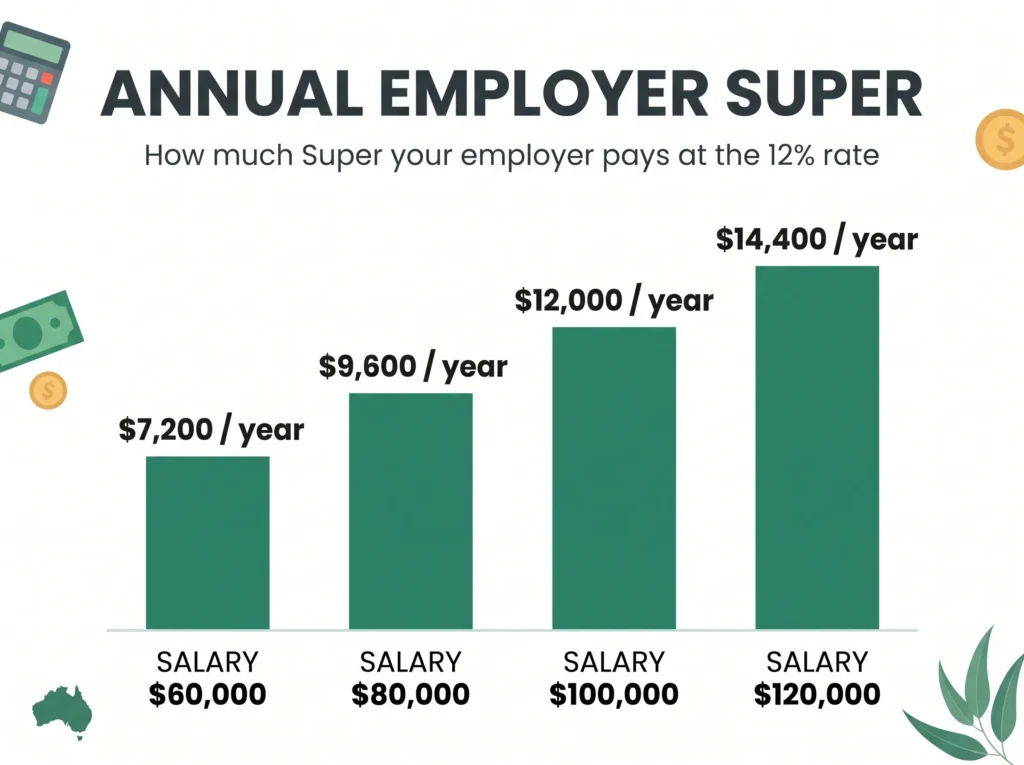
The super on a $100,000 salary is $12,000 a year, or about $462 a fortnight, taking your total package to $112,000. Enter your exact salary for a precise figure.
Worked example: super on an $80,000 salary
Say you earn $80,000 a year as an Australian resident. Your employer super is $80,000 times 12 percent, which is $9,600 a year. Split across the year that is about $369 a fortnight, or $800 a month, paid into your fund on top of your wage. Your total package, salary plus super, is $89,600.
If instead a job is advertised at “$89,600 including super,” the maths runs backwards: the $89,600 divides by 1.12 to give an $80,000 base salary and $9,600 of super. Same super, very different take-home, which is why the includes-super toggle matters when you compare offers.
Super on different pay types
Super is paid on ordinary earnings no matter how you are paid, so it works across salary, hourly, casual and part-time jobs.
Casual and part-time workers are entitled to super on their earnings too. The old rule that only paid super once you earned $450 in a month was removed in 2022, so every dollar of ordinary earnings now attracts super, even for a few hours of casual work. Overtime is the main thing left out, because it is not part of your ordinary hours, though a loaded-up rate that is not clearly overtime can still count. The calculator works on your ordinary pay, so if you regularly work paid overtime your real super may be a little higher.
Sole traders and contractors
If you run your own business as a sole trader, you are not required to pay yourself the super guarantee, so no employer super applies. Many sole traders still contribute to their own super voluntarily and claim it as a personal deduction, up to the same $32,500 concessional cap. If you work as a contractor but are paid mainly for your labour, you may actually be treated as an employee for super, which means the business paying you has to pay your super. The calculator shows what 12 percent of your earnings would be, which is a useful starting point either way.
Adding extra to your super
You can put more into super than your employer pays, and there are two ways to do it.
Salary sacrifice and the concessional cap
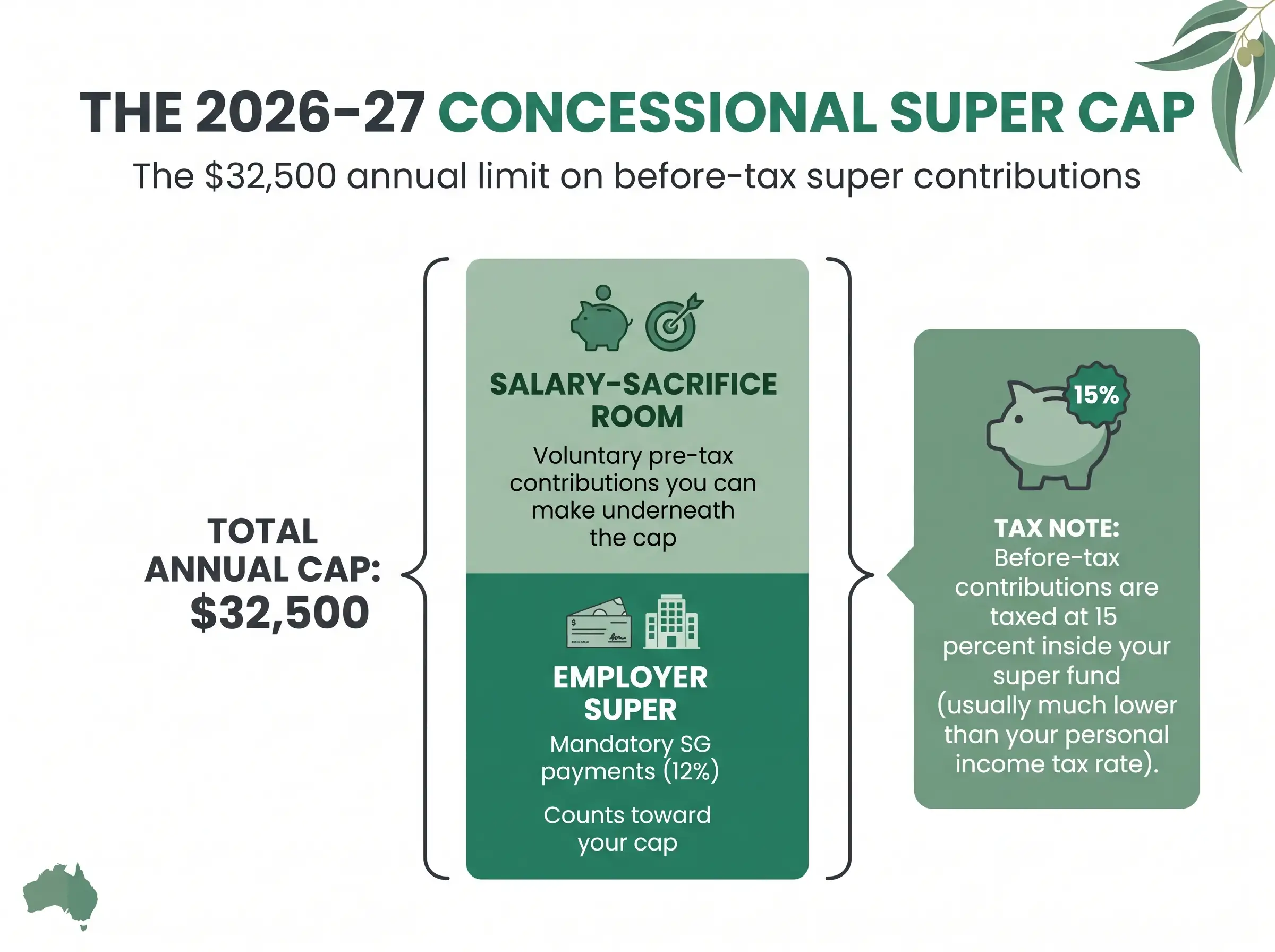
Salary sacrifice means asking your employer to pay some of your pre-tax salary straight into super. It lowers your taxable income, and the money is taxed at 15 percent going into super instead of your marginal rate. There is a limit on these before-tax contributions, called the concessional cap, which is $32,500 for 2026-27, up from $30,000 the year before. That cap includes the super your employer already pays, so your extra room is the cap minus your employer super. The calculator tracks this for you when you enter a salary-sacrifice amount, and warns you if you go over. For the full tax saving, use the salary sacrifice calculator.
After-tax contributions
You can also add money from your take-home pay, called non-concessional contributions. These have a separate, higher cap and are not taxed again going into super, because you already paid tax on that money. They suit people adding a lump sum, such as from savings or the sale of an asset.
How super is taxed
Super is taxed lightly to encourage you to save for later. Your employer’s contributions and any salary sacrifice are taxed at 15 percent as they go into your fund, which is lower than most people’s marginal tax rate. That is why salary sacrifice can leave you better off overall. If you earn more than $250,000 a year, an extra 15 percent applies to your contributions under a rule called Division 293. After-tax contributions are not taxed again on the way in.
What to do if your employer is not paying your super
First, check what has actually been paid. Log in to myGov, link the ATO, and look at your super contributions. Under Payday Super, contributions should appear within a few days of each pay from 1 July 2026, so a long gap is a warning sign.
If super is missing or short, raise it with your employer first, as it can be a payroll error. If it is still not fixed, you can report unpaid super to the ATO, which can investigate and recover it on your behalf. Keep your payslips, since they show the super your employer has reported against each pay.
Keeping track of your super
A few simple checks keep your super healthy. You can find lost or unclaimed super through myGov linked to the ATO, which shows every account in your name, including any the ATO is holding. If you have more than one account from different jobs, combining them can save you paying several sets of fees, though check any insurance attached before you move it.
When you start a new job, your super now follows you through a stapled super fund, so a new employer pays into your existing fund unless you choose a different one. This stops you ending up with a new account every time you change jobs.
How to use this calculator
- Enter your salary or wage and choose annual, monthly, fortnightly, weekly, daily or hourly.
- Tick “my salary includes super” if your figure is a total package.
- Add a salary-sacrifice amount if you want to track it against the concessional cap.
- Read your employer super for each pay cycle, with your total package.
Is this superannuation calculator accurate?
Yes, for working out employer super on a steady salary. It applies the 12 percent super guarantee rate for 2026-27 and the concessional cap, and it treats your salary as ordinary time earnings, which is correct for most employees.
It is a pay calculator, not a retirement projection. It does not estimate how much super you will have at retirement, since that depends on investment returns, fees and decades of contributions. If you want a retirement balance projection, the government’s Moneysmart super calculator is built for that. For how each figure here is worked out and when the rate was last checked, see our methodology page.
Frequently asked questions
How do I calculate superannuation in Australia?
Multiply your ordinary earnings by 12 percent. On a $65,000 salary that is $65,000 times 0.12, which is $7,800 of super a year for 2026-27.
Do casual and part-time workers get super?
Yes. Super is paid on all ordinary earnings regardless of how many hours you work, since the old $450 monthly minimum was removed in 2022.
Is super paid on overtime?
Generally no. Overtime is not part of your ordinary time earnings, so super usually is not paid on it, though your normal hours and most allowances do count.
How much can I salary sacrifice into super?
Your before-tax contributions, including your employer super, are capped at $32,500 for 2026-27. Your extra room is that cap minus what your employer already pays. See the salary sacrifice calculator for the tax effect.
Does my employer pay super on bonuses?
Usually yes. Most bonuses are part of your ordinary time earnings, so the 12 percent super applies to them, unless the bonus is clearly for overtime worked.
How do I find my super or lost super?
Log in to myGov and link the ATO, then open the super section. It lists all your accounts, including any lost or unclaimed super the ATO is holding for you, and lets you combine them in a few steps.
Is this a retirement projection calculator?
No. This works out the super your employer pays on your salary now. For a projection of your balance at retirement, use the Moneysmart super calculator.
Sources and references
Every figure was checked in September 2026 against official Australian sources.
- Australian Taxation Office, super guarantee rate and how to calculate it: ato.gov.au
- Australian Taxation Office, Payday Super and contribution caps: ato.gov.au
Reviewed by a registered tax agent
The rates and figures in this calculator were reviewed by James Wilson, CPA and registered Tax Agent with the Tax Practitioners Board, and Director of Australian Tax Advisors on the Gold Coast. The review covered the 2026-27 super guarantee rate, the concessional cap and the treatment of ordinary time earnings against current ATO rules. You can see James on LinkedIn.
Last reviewed by James Wilson, CPA, in September 2026.
Estimate only. This calculator provides general information and is not personal financial or tax advice. For advice about your own situation, speak with the ATO or a registered tax agent.