
Salary Sacrifice Calculator Australia
See the tax you save by sacrificing salary into super.
Tax saved by salary sacrificing
your take-home drops $0, but your super gains $0
Before and after salary sacrifice
| Without sacrifice | With sacrifice |
|---|
Sacrificed super is taxed at 15% going in (30% for income over $250,000 under Division 293), usually less than your marginal rate, which is where the saving comes from. Salary sacrifice does not reduce a HECS or HELP repayment. Rates verified against the ATO for 2026-27.
This salary sacrifice calculator shows the tax you save by sacrificing part of your salary into super, using the 2026-27 rates. Enter your salary and the amount you want to sacrifice, and it shows your take-home pay before and after, the extra super you gain, and your net benefit for the year. It was reviewed by James Wilson, CPA and registered Tax Agent.
How does salary sacrifice into super work?
Salary sacrifice into super means asking your employer to pay some of your before-tax salary straight into your super fund instead of into your bank account. That money is taxed at 15 percent as it goes into super, rather than at your normal marginal tax rate, which for most workers is 30 percent or more. The gap between those two rates is where the saving comes from, and the wider that gap, the more you keep.
You arrange it with your employer, who then redirects the agreed amount each pay. It has to be set up before you earn the money, not backdated. The sacrificed amount counts as an employer contribution, so it sits alongside the compulsory super your employer already pays, and it is reported to the ATO as a reportable super contribution.
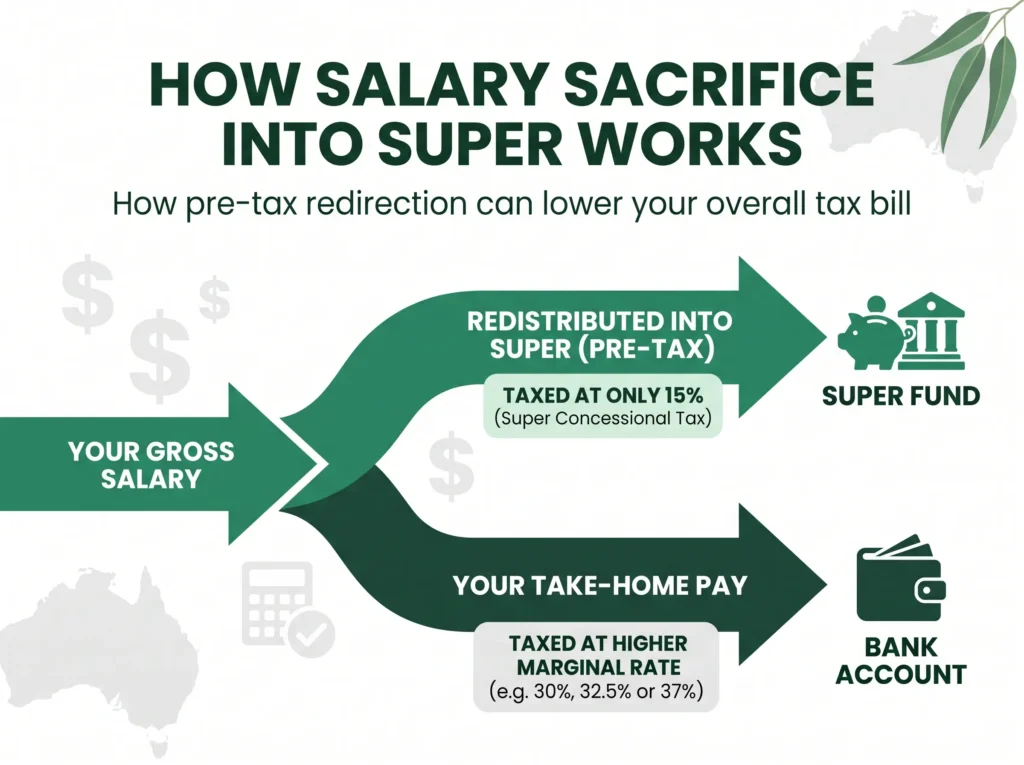
The appeal is simple. The same dollar is taxed once, at a lower rate, and lands in your retirement savings instead of being spread thin across your weekly spending. Over years, the difference between 15 percent and your marginal rate, compounded inside super, can add up to a meaningful amount by the time you retire. That is the reason the ATO allows it and why so many Australians use it once they can spare the cash.
How much tax do I save with salary sacrifice?
The saving depends on your income and how much you sacrifice. On a $90,000 salary, sacrificing $10,000 into super saves about $1,700 in net benefit for 2026-27. That is the income tax and Medicare levy you no longer pay on that $10,000, less the 15 percent contributions tax charged inside super.
Here is the full picture for that example. Your income tax and Medicare drop from $19,320 to $16,120, a saving of $3,200. The super fund takes 15 percent of the $10,000, which is $1,500. So your real gain is $3,200 minus $1,500, which is $1,700. The calculator above runs this for your own numbers and shows every line.
Does salary sacrifice reduce my take-home pay?
Yes, but by less than the amount you sacrifice, and your super goes up by more. This is the part that worries people, and it is worth seeing clearly.
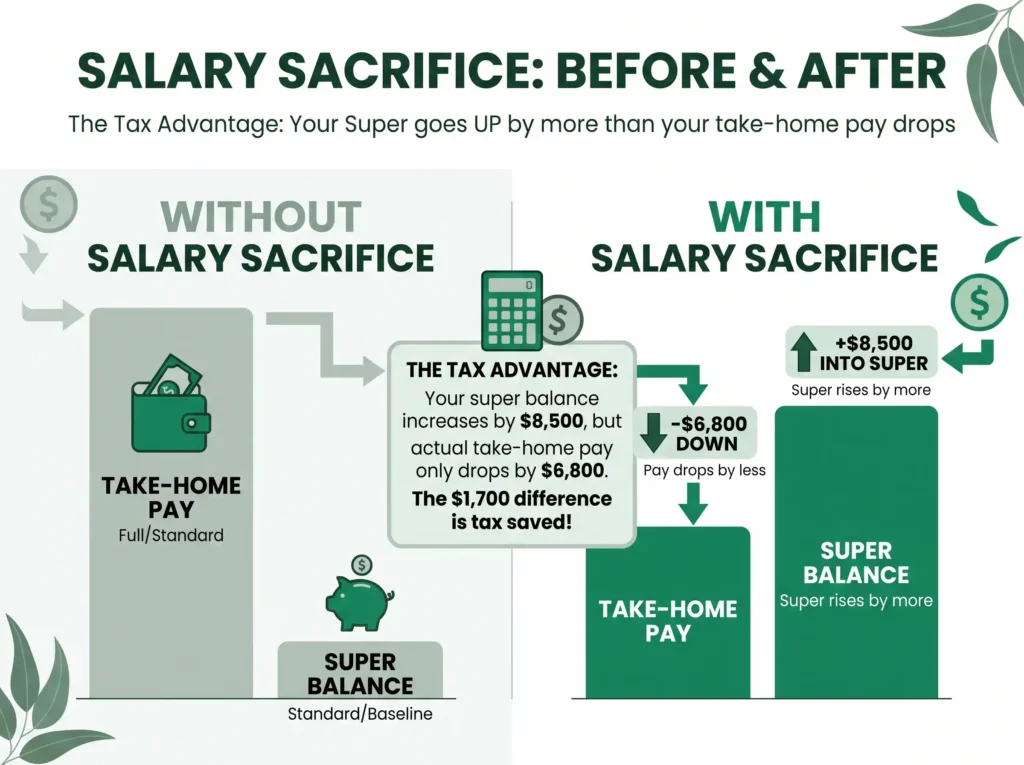
On that $90,000 example, sacrificing $10,000 drops your take-home pay by about $6,800, not the full $10,000. That is because you were paying tax on that money anyway, so giving it up only costs you the after-tax portion.
Meanwhile, your super receives $8,500, which is the $10,000 less the 15 percent contributions tax. So you are $6,800 lighter in the hand but $8,500 heavier in super, which is the $1,700 you come out ahead. The money is not lost; it has moved into super and grown in the move. This is why some people think salary sacrifice means more tax when they first see a smaller payslip; it does not. The tax is lower; the cash has just shifted into your fund.
Salary sacrifice savings by salary for 2026-27
This table shows the net benefit of sacrificing $10,000 into super at different salaries for 2026-27, for an Australian resident with no study loan. The saving grows once your income passes $135,000, because the money you sacrifice would have been taxed at 37 percent rather than 30.
Salary | Tax saved (net benefit) | Take-home drop | Super gained |
|---|---|---|---|
$60,000 | $1,850 | $6,650 | $8,500 |
$80,000 | $1,700 | $6,800 | $8,500 |
$100,000 | $1,700 | $6,800 | $8,500 |
$120,000 | $1,700 | $6,800 | $8,500 |
$150,000 | $2,400 | $6,100 | $8,500 |
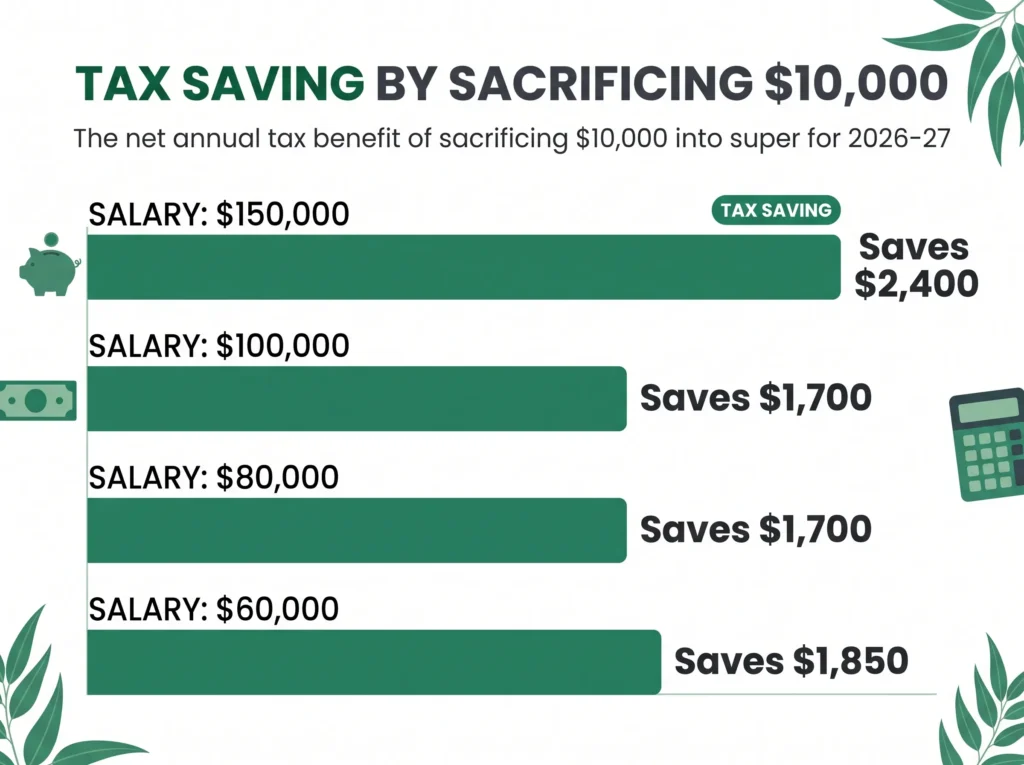
The higher your marginal tax rate, the bigger the gap between that rate and the 15 percent super rate, so the more salary sacrifice saves you. Someone on $150,000 saves $2,400 on the same $10,000, while the same sacrifice at $60,000 still returns $1,850 because of the Medicare levy and offset effects. Enter your own salary and sacrifice amount in the calculator for an exact figure.
Worked example: sacrificing $10,000 on an $80,000 salary
Say you earn $80,000 a year and decide to salary sacrifice $10,000 into super. Without the sacrifice, your income tax and Medicare levy come to $16,120, leaving take-home pay of $63,880. Your employer also pays $9,600 of super at the 12 percent rate.
With the sacrifice, your taxable income drops to $70,000. Your income tax and Medicare fall to $12,920, so your take-home pay is $57,080. That is $6,800 less in the hand. But your super now receives the $10,000 sacrifice less the 15 percent contributions tax, which is $8,500, on top of the $9,600 your employer already pays. So you have given up $6,800 of take-home pay to put $8,500 into super, and saved $1,700 in tax along the way. The money has moved to a lower-taxed place and grown in the move.
The fortnightly impact on your pay
Most Australians are paid fortnightly, so it helps to see the sacrifice at that level rather than as a yearly figure. Sacrificing $10,000 a year is about $385 a fortnight redirected into super. On that $80,000 salary, your take-home pay falls by around $262 a fortnight, since the rest of the $385 would have gone to tax anyway.
Breaking it down this way makes the decision more concrete. You are choosing to live on about $262 less each fortnight in exchange for roughly $327 a fortnight going into super after contributions tax, plus the yearly tax saving. For many people that trade is easier to judge per pay than as a single large annual number, which is why the calculator shows both. If money is tight, you can start with a small amount, even $50 a fortnight, and lift it later when a pay rise lands, rather than committing to a large sacrifice straight away.
How much can I salary sacrifice into super?
You can sacrifice up to the concessional contributions cap, which is $32,500 for 2026-27, up from $30,000 the year before. The important catch is that this cap includes the compulsory super your employer already pays, not just your sacrifice. So your real sacrifice room is the cap minus your employer super.
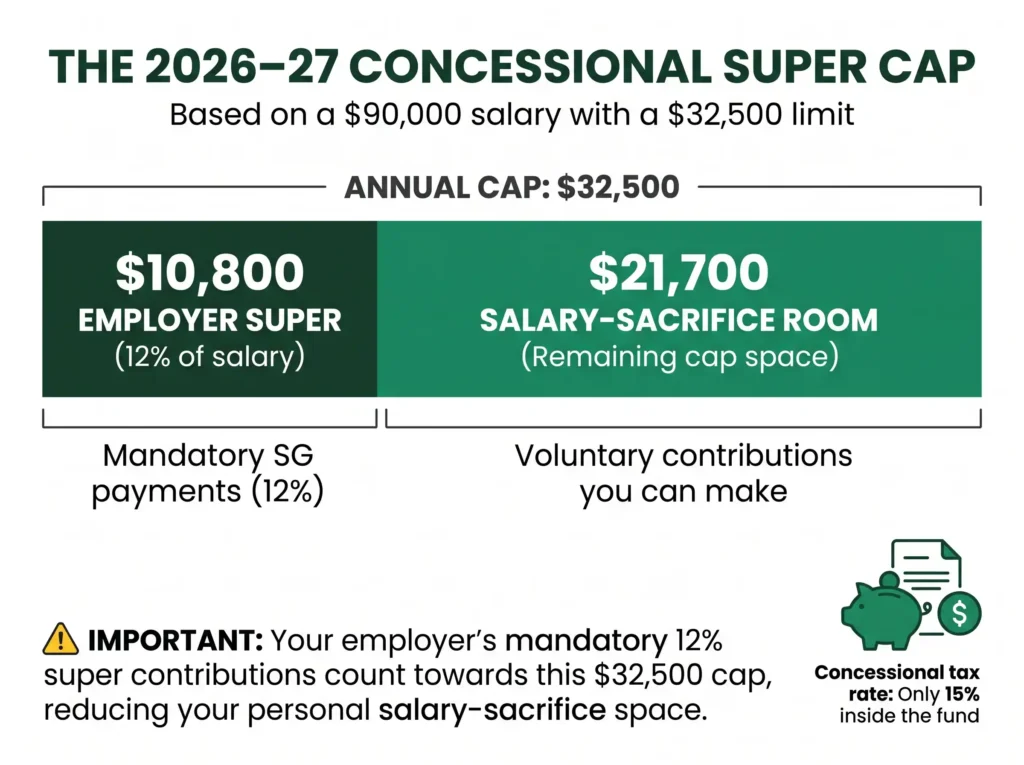
For example, on a $90,000 salary your employer pays $10,800 of super at the 12 percent rate. That leaves $21,700 of room under the $32,500 cap for you to salary sacrifice. If you go over the cap, the excess is added back to your taxable income and taxed at your marginal rate, with a small interest charge, so the benefit disappears above the cap. The calculator tracks this for you and warns you if your employer super plus your sacrifice goes over the annual limit.
You also cannot sacrifice your entire salary. Your employer still has to pay you at least the national minimum wage and meet award and tax obligations, so there is a practical floor on how low your cash salary can go.
Does the Superannuation Guarantee count towards the cap?
Yes. Your employer’s compulsory Super Guarantee contributions count towards the same $32,500 concessional cap as your salary sacrifice. They are both before-tax contributions, so the ATO counts them together.
This is why you cannot simply sacrifice $32,500 on top of your employer super. On a $90,000 salary, your $10,800 of employer super already uses part of the cap, leaving $21,700 for sacrifice. People who forget this can accidentally breach the cap and lose the saving, so it is worth checking your employer super first.
Does salary sacrifice reduce my HECS or HELP repayment?
No. This surprises a lot of people. Salary sacrifice lowers your taxable income, but it does not lower your HECS or HELP repayment, because the sacrificed amount is added back when the ATO works out your repayment income.
Your compulsory study loan repayment is based on your repayment income, which is your taxable income plus reportable super contributions, and salary sacrifice is a reportable super contribution. So the ATO adds it straight back. If you have a HECS debt, you still get the income tax saving from salary sacrifice, but your repayment stays the same as if you had not sacrificed at all. You can check how your repayment is worked out on our HECS repayment calculator. The one upside is that the income tax saving still applies, so salary sacrifice is not pointless with a study loan, it just does not touch the repayment itself.
How salary sacrifice is taxed, and Division 293
Salary sacrifice works because of the tax rates involved. Money you sacrifice is taxed at 15 percent as it enters your super fund, which is the concessional contributions rate. For most workers that is well below their marginal tax rate of 30, 37 or 45 percent, so the money is taxed far more lightly than if you took it as salary.
There is one exception for high earners. If your income plus your concessional contributions is more than $250,000 a year, an extra 15 percent tax applies to some or all of your contributions under a rule called Division 293. That lifts the contributions tax from 15 to 30 percent for the affected amount. Even at 30 percent, salary sacrifice can still beat the top marginal rate of 45 percent plus the Medicare levy, but the saving is smaller, so high earners should run their own numbers carefully.
Is salary sacrifice into super worth it?
For most people with spare income, yes, because the tax saving is real and it grows your retirement savings at the same time. The catch is that the money is locked in super until you reach preservation age, usually your late fifties or sixties. So it suits money you do not need to spend before then.
Salary sacrifice is worth it when you have income above the point where you pay 30 percent tax, you are comfortably under the concessional cap, and you do not need that cash for shorter-term goals like a home deposit or paying down higher-interest debt.
It is less suited to someone who might need the money soon, since you cannot easily get it back out before preservation age except in very limited hardship cases. A common approach is to balance it, putting enough into super to capture a solid tax saving while keeping enough cash free for your shorter-term plans. This is general information, not personal advice, so weigh it against your own goals or talk to a licensed financial adviser.
Salary sacrifice versus after-tax super contributions
There are two ways to put extra into super, and they are taxed differently. Salary sacrifice is a before-tax, or concessional, contribution, taxed at 15 percent going in and counted against the $32,500 cap. After-tax, or non-concessional, contributions come from money you have already paid tax on, so they are not taxed again going into super, and they have a separate, higher cap.
There is also a middle option. You can make a personal contribution from your take-home pay and then claim it as a tax deduction, which turns it into a concessional contribution with the same effect as salary sacrifice. This suits people whose employer does not offer salary sacrifice, or who get a bonus or a lump sum partway through the year. The end tax result is similar, so the choice often comes down to what is easiest to set up with your employer and your fund.
Salary sacrifice into super versus salary packaging
Salary sacrifice into super is one type of salary packaging, but the two terms are not the same. Salary packaging is the broader idea of taking part of your pay as something other than cash, which can include a car through a novated lease, a laptop, or living expenses if you work for a not-for-profit or health employer.
This calculator and this page are about sacrificing into super, which is the most common form and the one with the clearest tax rules. Packaging a car or other item works differently, because it can attract Fringe Benefits Tax and the maths depends on the item and your employer’s arrangement. If you are weighing up a novated lease or other packaging, that is a separate calculation with its own rules, and the figures here will not apply to it. For super, the rules are the ones set out above: taxed at 15 percent going in, capped at $32,500 a year including employer super.
Can casual and part-time workers salary sacrifice?
Yes, if your employer offers it. Salary sacrifice is not limited to full-time staff. Casual and part-time employees can arrange it the same way, as long as their employer agrees to redirect part of their pay into super.
The main thing to watch on lower or irregular incomes is whether the saving is worth locking the money away. The tax benefit is smaller at lower marginal rates, and casual income can be less predictable, so the cash in hand may matter more. If your income sits below the 30 percent bracket, the saving may be too small to justify tying up the money. Run your own figures in the calculator before deciding.
How to set up salary sacrifice with your employer
Setting it up is straightforward, but the timing matters. You agree the amount with your employer in writing before you earn the pay it applies to, because it cannot be backdated to income you have already received. Your employer then redirects that amount into your nominated super fund each pay cycle.
It is worth reviewing the arrangement each year, especially around 1 July when the concessional cap and your salary may change. If you get a pay rise, your employer super rises too, which uses more of the cap and leaves less room for sacrifice. Keep an eye on the total so you stay under the limit across the full financial year.
How to use this calculator
- Enter your salary, before tax and excluding super.
- Enter the amount you want to salary sacrifice into super for the year.
- The calculator shows your take-home pay before and after, the extra super, and your net benefit.
- Check the concessional cap bar to make sure your employer super plus your sacrifice stays under $32,500.
Is this salary sacrifice calculator accurate?
Yes, for working out the tax effect on a steady salary. It applies the 2026-27 resident tax rates, the Low Income Tax Offset, the 2 percent Medicare levy, the 15 percent contributions tax and the $32,500 concessional cap. It compares your position with and without the sacrifice so you can see the saving directly.
It is an estimate for planning, not personal financial advice. It does not model Division 293 tax for incomes over $250,000, government benefit effects, or non-super packaging like a novated lease, which work differently. Your own result can vary with your full circumstances. See our methodology page for how each figure is worked out and when the rates were last checked, and speak with a licensed financial adviser before you act on it.
Frequently asked questions
What is salary sacrifice?
It is an agreement to have part of your before-tax salary paid into super instead of your bank account, so it is taxed at 15 percent rather than your marginal rate. It lowers your take-home pay but lifts your super by more.
Can I salary sacrifice my whole salary?
No. Your employer still has to pay you at least the minimum wage and meet award and tax rules, and before-tax super contributions are capped at $32,500 a year including employer super. So there is both a floor on your cash salary and a ceiling on the sacrifice.
Can casuals salary sacrifice?
Yes, if the employer offers it. Casual and part-time workers can salary sacrifice the same way as full-time staff, though the saving is smaller at lower tax rates.
What is the difference between salary sacrifice and personal contributions?
Salary sacrifice is arranged through your employer from before-tax pay. A personal deductible contribution comes from your take-home pay and you claim it back as a deduction. Both are concessional and have a similar tax result.
Can I change or stop my salary sacrifice?
Yes. You can change or stop the arrangement for future pays by agreement with your employer. You cannot change it for pay you have already received.
Does salary sacrifice reduce the Medicare levy?
It can slightly, because the levy is charged on your taxable income and salary sacrifice lowers that income. The effect is small compared with the income tax saving.
What happens if I go over the concessional cap?
The excess is added back to your taxable income and taxed at your marginal rate, with an interest charge, so the benefit is lost above the cap. Staying under $32,500, including employer super, keeps the full saving.
Is there a minimum amount I can salary sacrifice?
There is no legal minimum set by the ATO. Your employer or super fund may set a small minimum for practical reasons, but you can usually sacrifice as little or as much as you like, up to the concessional cap.
Can I salary sacrifice on my own without my employer?
No. Salary sacrifice has to be arranged through your employer, since it is your employer who redirects the pay. If your employer does not offer it, the alternative is to make a personal contribution from your take-home pay and claim it as a tax deduction, which gives a similar result.
Does salary sacrifice affect government benefits?
It can. Reportable super contributions are counted in the income tests for some payments and benefits, so sacrificing a large amount may change your entitlement. Check your situation if you receive income-tested payments.
Sources and references
Every figure was checked in October 2026 against official Australian sources.
- Australian Taxation Office, salary sacrificing super and how it is taxed: ato.gov.au
- Australian Taxation Office, concessional contributions cap and Division 293: ato.gov.au
Reviewed by a registered tax agent
The rates and figures in this calculator were reviewed by James Wilson, CPA and registered Tax Agent with the Tax Practitioners Board, and Director of Australian Tax Advisors on the Gold Coast. The review covered the 2026-27 tax rates, the 15 percent contributions tax, the concessional cap and the treatment of reportable super contributions against current ATO rules. You can see James on LinkedIn.
Estimate only. This calculator provides general information and is not personal financial or tax advice. For advice about your own situation, speak with the ATO or a licensed financial adviser.
Last reviewed by James Wilson, CPA, in October 2026.