Income Tax Calculator Australia
See how much income tax you pay and how the brackets apply to your income.
Your income tax
plus $0 Medicare levy. Total tax and levies $0
Your income tax, bracket by bracket
Tax by pay cycle
| Period | Tax & levies | Take-home |
|---|
Full gross-to-net breakdown
Estimate only, not financial advice. Rates verified against the ATO for 2026-27. Thresholds are indexed each July, so re-check then.
This income tax calculator shows how much tax you pay on your salary in Australia, worked out bracket by bracket using ATO rates for the 2026-27 financial year. Enter your income and residency, and the calculator shows your income tax, the Medicare levy, your marginal and effective rate, and what you take home. It was reviewed by James Wilson, CPA and registered Tax Agent.
Your income tax, worked out
Most calculators just hand you a number. This one shows the working, so you can see exactly where your tax comes from.
How much tax you pay
The result splits your tax into two parts, the income tax itself and the 2 percent Medicare levy, then adds them for your total. If you have a study loan, a HELP or HECS repayment is shown too. Together these are the amount the Australian Taxation Office collects on your income.
Your income tax, bracket by bracket
The table shows how much of your income falls in each tax bracket and the tax charged on that slice. This is the part people find most useful, because it makes clear that you do not pay one flat rate on everything you earn.
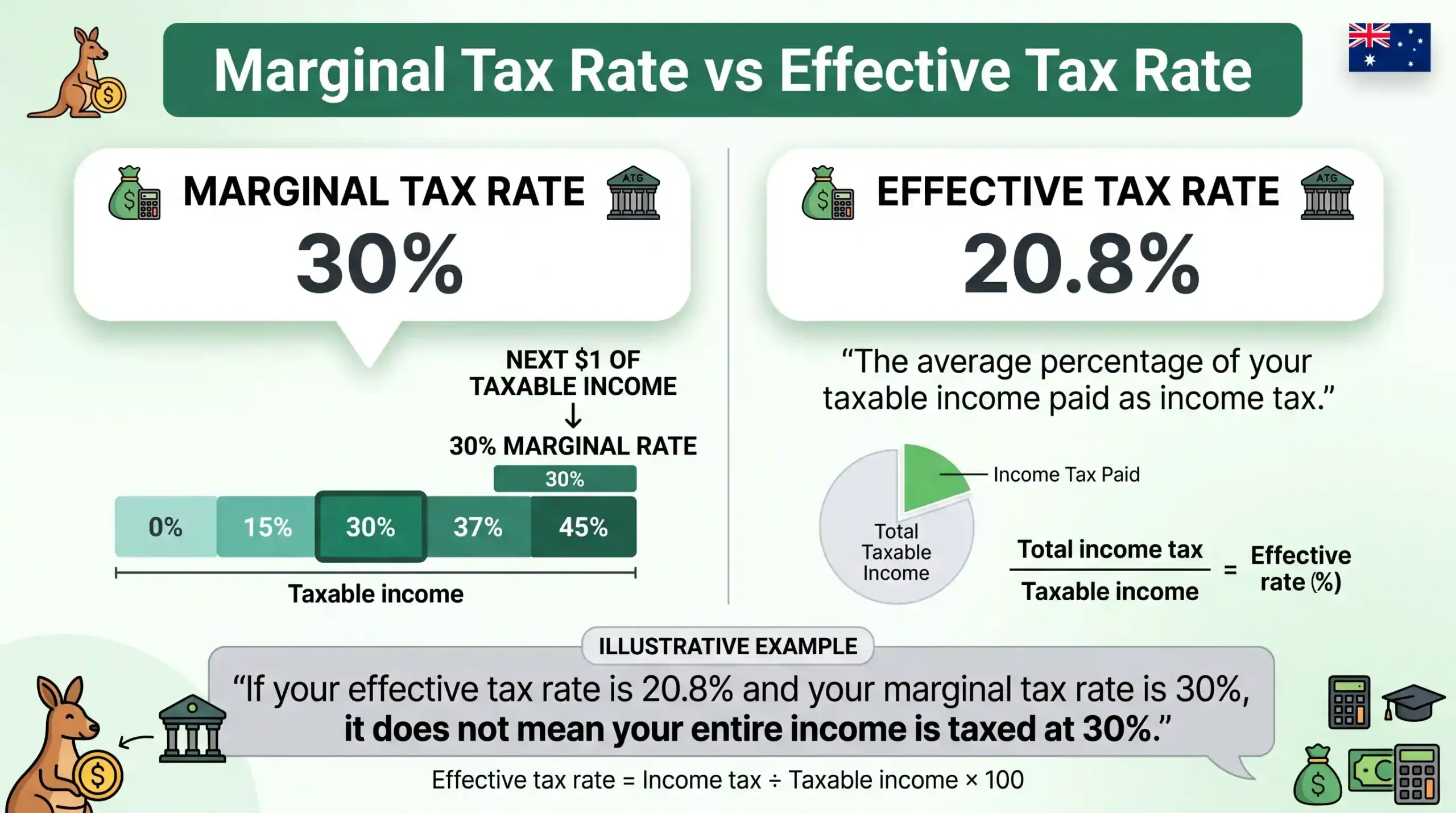
Your marginal rate versus your effective rate
Your marginal rate is the rate on your next dollar. Your effective rate is your total tax as a share of your whole income. The effective rate is always lower, because your first $18,200 is tax free and the lower brackets are taxed at 15 and 30 percent.
How much income tax will I pay in Australia?
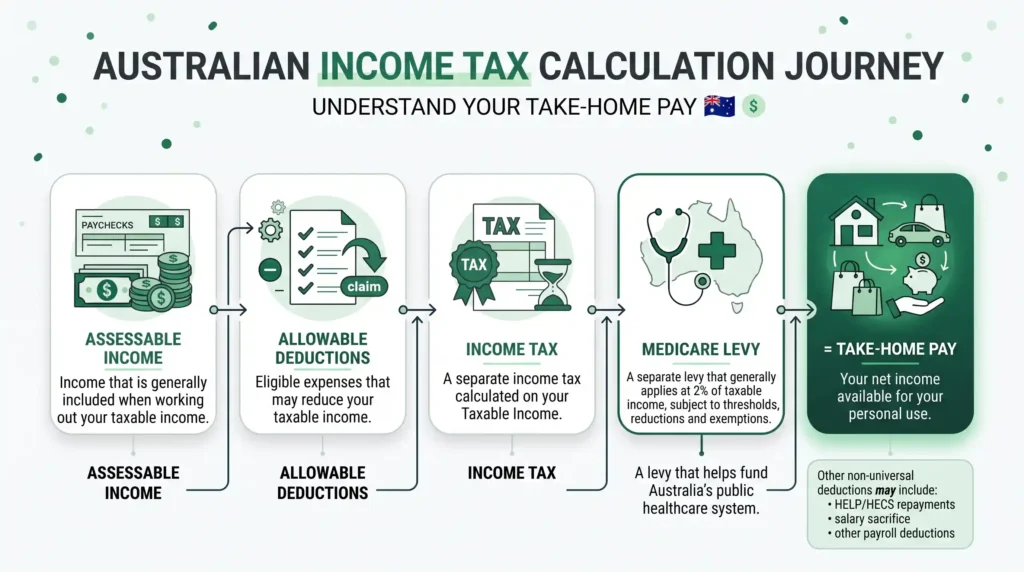
Your income tax depends on your taxable income and the 2026-27 brackets: nothing on the first $18,200, 15 percent up to $45,000, 30 percent up to $135,000, 37 percent up to $190,000, and 45 percent above that. On top of that, most residents also pay the 2 percent Medicare levy.
So a resident on $80,000 pays $14,520 in tax plus $1,600 Medicare levy, which is $16,120 in total. Enter your own figure to see your exact tax.
Do I pay tax on my whole income?
No. Australia uses marginal tax rates, which means each rate applies only to the slice of income inside its bracket, not to your whole income. Your first $18,200 is always tax free, even if you earn $200,000.
This is the point most people get wrong. Earning a dollar more never leaves you with less overall, because only that extra dollar is taxed at the higher rate. A pay rise always adds to your take-home pay, just not the full amount.
How the tax brackets are applied
Here is how the calculator builds the tax on an $80,000 salary for a resident in 2026-27, one slice at a time.
The first $18,200 is tax free, so that part costs nothing. The next slice, from $18,201 to $45,000, is $26,800 taxed at 15 percent, which is $4,020. The slice from $45,001 to $80,000 is $35,000 taxed at 30 percent, which is $10,500. Add those together and the tax is $14,520. The Medicare levy adds 2 percent of $80,000, which is $1,600. That is the full working behind the figure.
Australian income tax rates 2026-27
These are the resident rates for the financial year running from 1 July 2026 to 30 June 2027. They do not include the 2 percent Medicare levy.
Taxable income | Tax rate on that slice |
|---|---|
$0 to $18,200 | 0 percent |
$18,201 to $45,000 | 15 percent |
$45,001 to $135,000 | 30 percent |
$135,001 to $190,000 | 37 percent |
$190,001 and over | 45 percent |
The 15 percent rate is new for this year. On 1 July 2026 the second bracket dropped from 16 percent to 15 percent under legislated cost of living tax cuts, worth up to $268 a year for anyone earning $45,000 or more. A further cut to 14 percent is already legislated for 1 July 2027.
What counts as taxable income
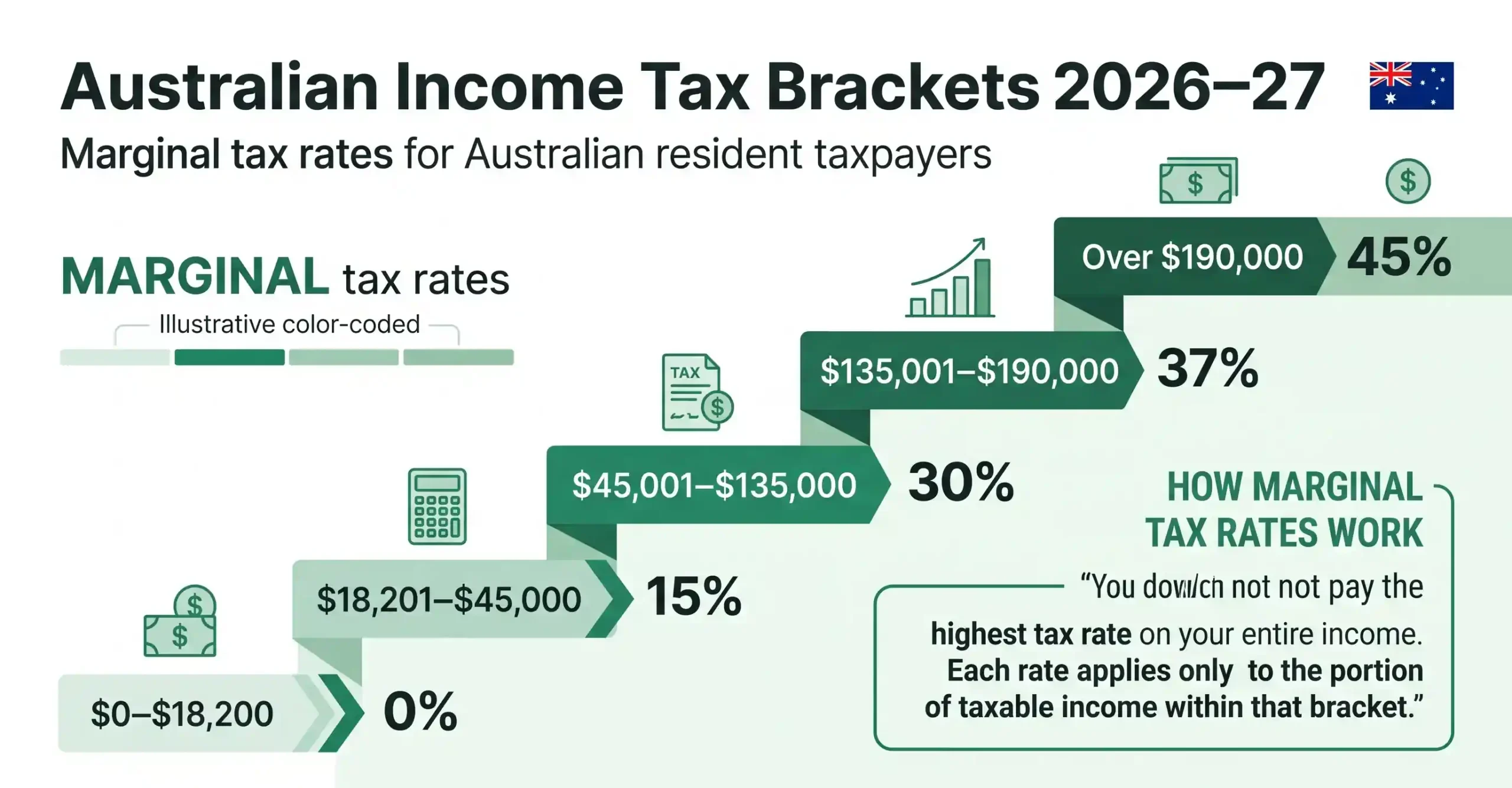
Your tax is charged on your taxable income, not your gross salary. Taxable income is your assessable income, such as your salary, wages and any investment income, minus your allowable deductions, such as work related expenses. For most employees on a single salary, taxable income is close to gross pay, so the calculator uses your salary as the starting point.
What is added on top of income tax
Medicare levy
Most Australian residents pay a Medicare levy of 2 percent of taxable income, which helps fund the public health system. A reduced levy or none applies to low income earners. For a single person in 2026-27, no levy applies below $28,011.
Medicare Levy Surcharge
This is a separate charge of 1 to 1.5 percent for higher earners who do not hold private hospital cover. Taking out basic hospital cover can remove it for people over the threshold, and the calculator shows it as its own line.
HELP and HECS repayments
If you have a study loan, you repay it through the tax system once your income passes $69,528 for 2026-27. It is a marginal repayment, so you repay a percentage only of the income above the threshold. Tick the HECS box to include it.
How tax offsets lower your tax
A tax offset reduces the tax you owe, dollar for dollar. The main one for employees is the Low Income Tax Offset (LITO), worth up to $700 for people earning up to $37,500 and phasing out by $66,667. Because of it, most residents pay no income tax until they earn around $22,867. The older Low and Middle Income Tax Offset has ended and no longer applies.
Does overtime push you into a higher bracket for the whole year?
No. Only the income that falls above a bracket line is taxed at the higher rate, not your whole income. Overtime can look heavily taxed on a single payslip, because your employer withholds that pay as if you earned at that rate all year. It usually evens out when you lodge your return, and any extra held back comes back as a refund.
Income tax by residency
Australian residents
Residents get the $18,200 tax-free threshold, the resident rates above, and pay the Medicare levy. Most people who live and work here full time are residents for tax purposes.
Foreign residents
Foreign residents get no tax-free threshold and pay 30 percent from the first dollar up to $135,000. They do not pay the Medicare levy, so their tax is worked out differently from a resident’s.
Working holiday makers
On a 417 or 462 visa, your first $45,000 is taxed at a flat 15 percent, with no tax-free threshold and no Medicare levy. Switch the residency setting to see the working holiday figures.
How much tax on common salaries in 2026-27
This is the tax for a single Australian resident with private hospital cover and no study loan, using the verified 2026-27 rates. These match the calculator above.
Annual salary | Income tax | Medicare levy | Total tax | Take home pay |
|---|---|---|---|---|
$60,000 | $8,420 | $1,200 | $9,620 | $50,380 |
$80,000 | $14,520 | $1,600 | $16,120 | $63,880 |
$100,000 | $20,520 | $2,000 | $22,520 | $77,480 |
$120,000 | $26,520 | $2,400 | $28,920 | $91,080 |
The tax on a $100,000 salary is $20,520 plus $2,000 Medicare levy, which is $22,520 in total. Enter your exact figure for a precise result.
What you need to work out your income tax
You need your gross income, your residency for tax purposes, the financial year, and whether you have a study loan. Tick “includes super” if your figure is a total package, and the calculator pulls the super back out first, since super is not part of your taxable income.
How to use this calculator
- Enter your income and choose annual, monthly, fortnightly, weekly, daily or hourly.
- Set your residency: Australian resident, foreign resident or working holiday maker.
- Tick HECS or HELP, and private cover, if they apply.
- Read your income tax, the bracket breakdown, and your marginal and effective rate.
Why does the ATO or myTax estimate differ from your tax return?
The estimate on myTax and the ATO simple calculator is based on the figures entered at that moment, before all your income, deductions and offsets are final. Your actual tax is settled once your full return is processed. So a small difference is normal, and this calculator gives an accurate estimate for a full year at a steady income.
Is this income tax calculator accurate?
Yes, for a full year at a steady income. It applies the ATO 2026-27 rates and formulas: the resident, foreign resident and working holiday scales, the tax-free threshold, LITO, the 2 percent Medicare levy and the HELP thresholds. It gives an estimate, not a notice of assessment, and it does not replace advice from the ATO or a registered tax agent. See our methodology page for how each figure is worked out and when the rates were last checked.
Frequently asked questions
Is the Medicare levy income tax?
No, it is a separate 2 percent charge that funds public healthcare, worked out on your taxable income and collected alongside your tax.
What is the tax-free threshold?
The first $18,200 you earn in a financial year is tax free if you are an Australian resident. You claim it from one job only.
How much tax do I pay on $80,000?
About $16,120 in total for a resident in 2026-27, which is $14,520 in tax plus $1,600 Medicare levy.
How much tax do I pay on $100,000?
About $22,520 in total, which is $20,520 in tax plus $2,000 Medicare levy.
Will I get a refund or a tax bill?
It depends on whether your employer withheld more or less than your final tax. If they held back more, you get a refund. If less, you get a bill when you lodge.
When do I lodge my tax return?
The financial year ends on 30 June. If you lodge your own return, it is usually due by 31 October. A registered tax agent can lodge later on your behalf.
How is a second job taxed?
You claim the tax-free threshold from one job only, so your second job is taxed from the first dollar at your marginal rate. That prevents a tax bill at the end of the year.
Sources and references
Every figure was checked in September 2026 against official Australian sources.
- Australian Taxation Office, individual income tax rates, Medicare levy and HELP: ato.gov.au
- Fair Work Ombudsman, awards and pay: fairwork.gov.au
Reviewed by a registered tax agent
The tax rules and 2026-27 figures in this calculator were reviewed by James Wilson, CPA and registered Tax Agent with the Tax Practitioners Board, and Director of Australian Tax Advisors on the Gold Coast. The review covered the income tax brackets, the Medicare levy and HELP amounts against current ATO rates. You can see James on LinkedIn.
Last reviewed by James Wilson, CPA, in September 2026.
Estimate only. This calculator provides general information and is not personal financial or tax advice. For advice about your own situation, speak with the ATO or a registered tax agent.